
The person who wants to buy from you isn’t the only one who has to say yes.
Forrester’s The State of Business Buying, 2026 reports that a typical buying decision involves 13 internal stakeholders and 9 external influencers, with those numbers rising for more complex purchases. 6sense’s 2025 B2B Buyer Experience Report found that 95% of deals go to a vendor already on the buyer’s Day One shortlist.
By the time sales enters the conversation, buyers may already be comparing vendors, validating claims, and building internal consensus. That changes the website’s job. It has to do more than attract interest and generate a lead. It has to help buyers verify the case, answer hard questions, and keep the decision moving when no one from your team is there to explain it.
A decision room-ready website helps buyers explain, defend, and advance the decision without your sales team in the meeting.
The Room-Readiness Framework focuses on five capabilities that help an enterprise website carry more of that work on its own.
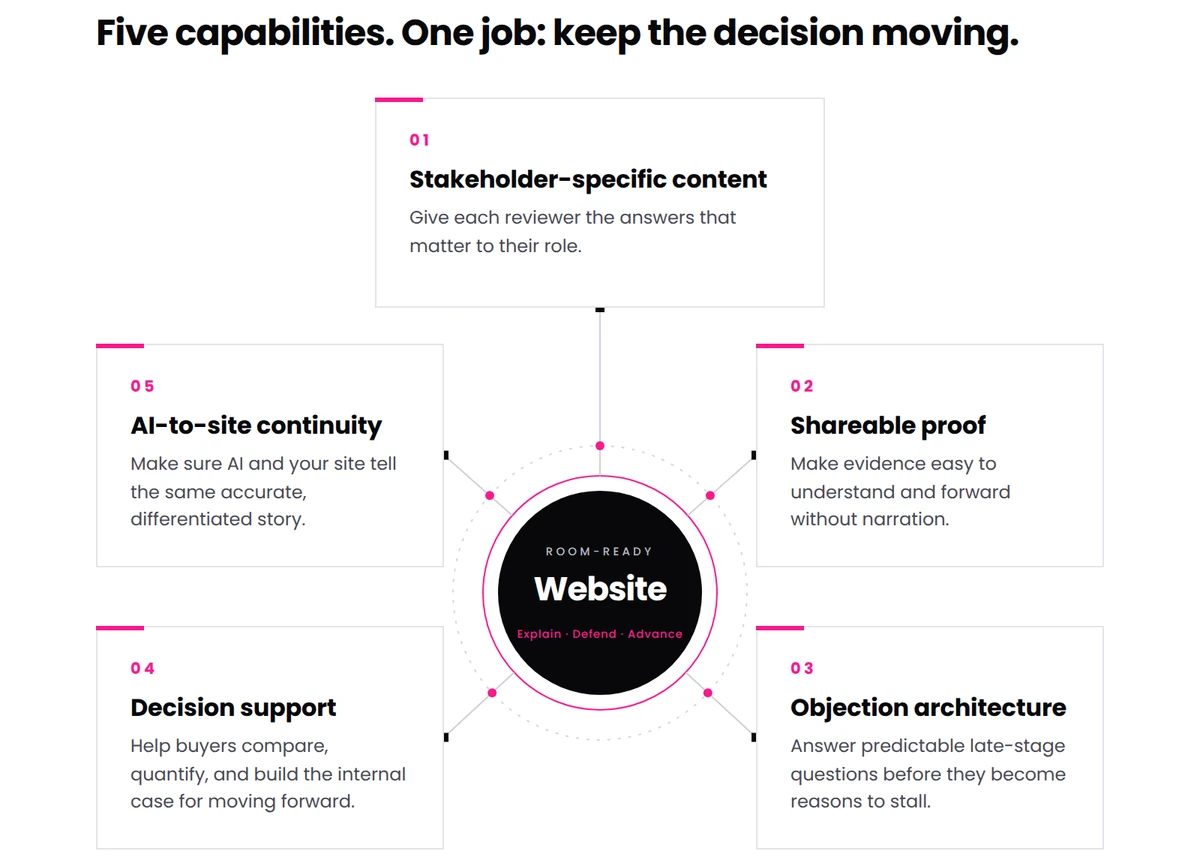
1. Stakeholder-specific content
Every evaluator should be able to find the answer they need.
Finance wants ROI and total cost. Security wants risk and compliance answers. Technical owners want to understand integrations and implementation. End users care about what changes for them.
If the website gives everyone the same generic message, the person advocating for you is left translating it for everyone else. A room-ready site makes the important decision questions easy for each reviewer to answer.
That does not require a separate page for every job title. It can mean dedicated pages, role-based sections, FAQs, technical documentation, or proof organized around the concerns that actually shape the decision.
Start here:
Name the three roles most likely to slow your next complex deal. Can each one find a clear answer to their top question without someone else translating it for them?
2. Shareable proof
Proof has to make sense after it gets forwarded.
Case studies, results, comparisons, and URLs often get forwarded into conversations you are not part of. Someone receiving your strongest proof with no context should be able to understand who the customer was, what problem they had, what changed, and what result you produced without anyone narrating the story.
The strongest proof is self-contained, specific, easy to skim, and easy to share. It gives a new reviewer enough context to understand why the result matters, not only what happened.
Start here:
Send your strongest case study to someone outside your company with no explanation. If they have to ask what happened, why it mattered, or what the result was, it is not ready to travel.
3. Objection architecture
The questions that slow a decision are usually predictable.
Late-stage deals often lose momentum when harder questions surface. What will switching take? What could go wrong? What will this cost? How will implementation work? What happens if we do nothing?
Objection architecture puts clear answers to recurring concerns where buyers can find and forward them. That does not mean publishing every commercial detail. It means not forcing sales to answer the same predictable questions from scratch every time.
Start here:
List the last three questions that slowed a deal late. Does your website answer any of them clearly, in writing, without requiring a call?
4. Decision support
Give buyers something useful to take into the meeting.
A buyer can read an entire website and still have nothing concrete to use in an internal discussion. Decision support helps them compare, calculate, validate, or build the case on their own.
That could be an ROI calculator, comparison guide, migration checklist, assessment, business-case template, or another useful output. It does not have to be interactive. The point is to help the buyer do something with the information, not just read it.
Start here:
Ask what a buyer can produce on your website without talking to sales. A number? A comparison? An assessment? A business case? If the answer is nothing, that is the gap.
5. AI-to-site continuity
AI should repeat the same story buyers can verify on your website.
Buyers may use AI to summarize your company, compare you with alternatives, or surface proof before they read a page themselves. If your claims shift from page to page, important proof is buried, or key information is hard to access, the next conversation can start from an incomplete version of your story.
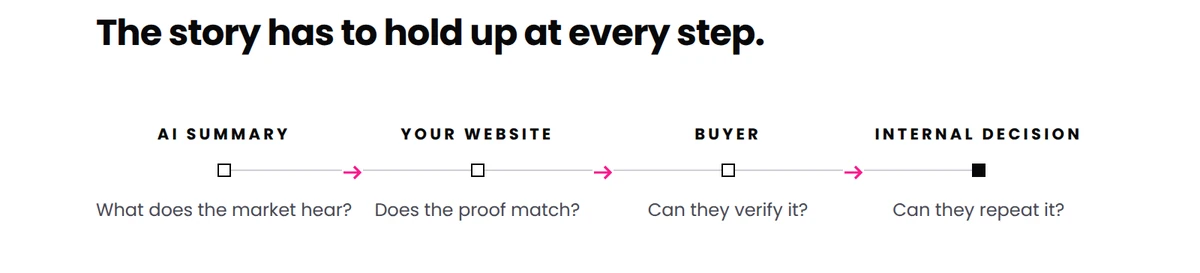
AI-to-site continuity means your most important claims are consistent, accessible, and supported by proof wherever buyers or AI encounter them. Structured data can help reinforce important facts, but the first job is simpler: make the story consistent and the proof easy to find.
Start here:
Ask an AI tool to summarize your company, then compare the answer with your website. Does it surface the same three or four things your sales team wants buyers to remember? If not, start with the gap between the two.
Can your website do these five things without you?
Use the framework as a simple yes-or-not-yet check. If one of these capabilities is missing, your website is asking someone else to do the work.
Go deeper
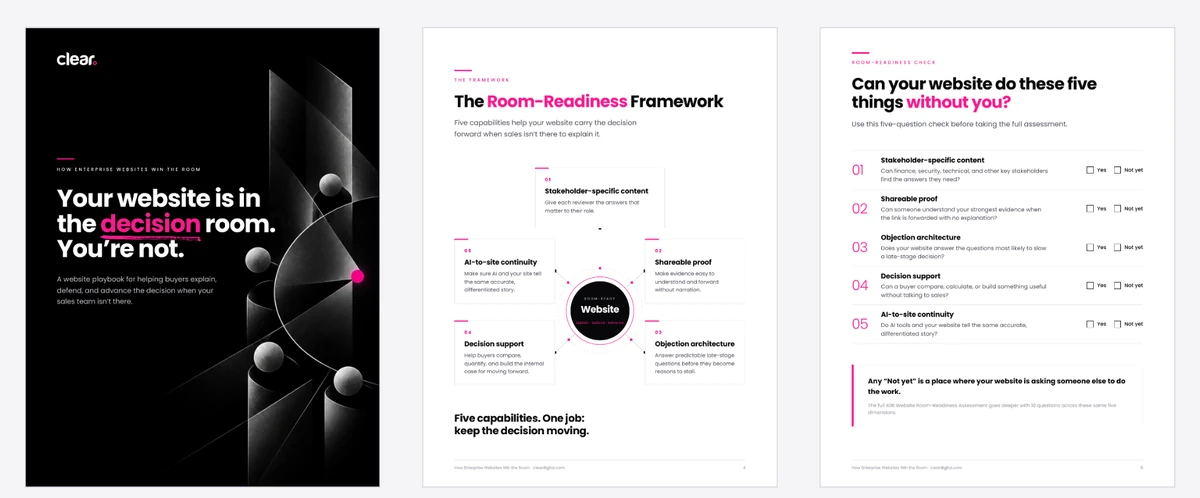
How Enterprise Websites Win the Room includes the full framework, examples, and a 45-minute website decision audit your team can run together.
Take the B2B Website Room-Readiness Assessment →
10 questions. 2 minutes. 15 points. See where your website is most likely to create friction in the decision.
Sources
Forrester, The State of Business Buying, 2026
13 internal stakeholders and nine external influencers participate in a typical buying decision, with the number rising for more complex or strategic purchases.
6sense, 2025 B2B Buyer Experience Report
95% of deals go to a vendor already on the buyer’s Day One shortlist.
Last reviewed: September 2026
Get our latest insights in your inbox

8 Criteria for Choosing a B2B Web Redesign Agency
By Clear Digital on September 15, 2026
Read more
What a B2B Website Redesign Requires From Your Team
By Clear Digital on September 11, 2026
Read more
How to Justify a Website Redesign to Your CEO, CFO, or Board
By Clear Digital on September 11, 2026
Read more