Most B2B marketing effort goes into producing content, not measuring its impact. AI shifts that equation by making analysis fast enough to actually inform what gets made next.

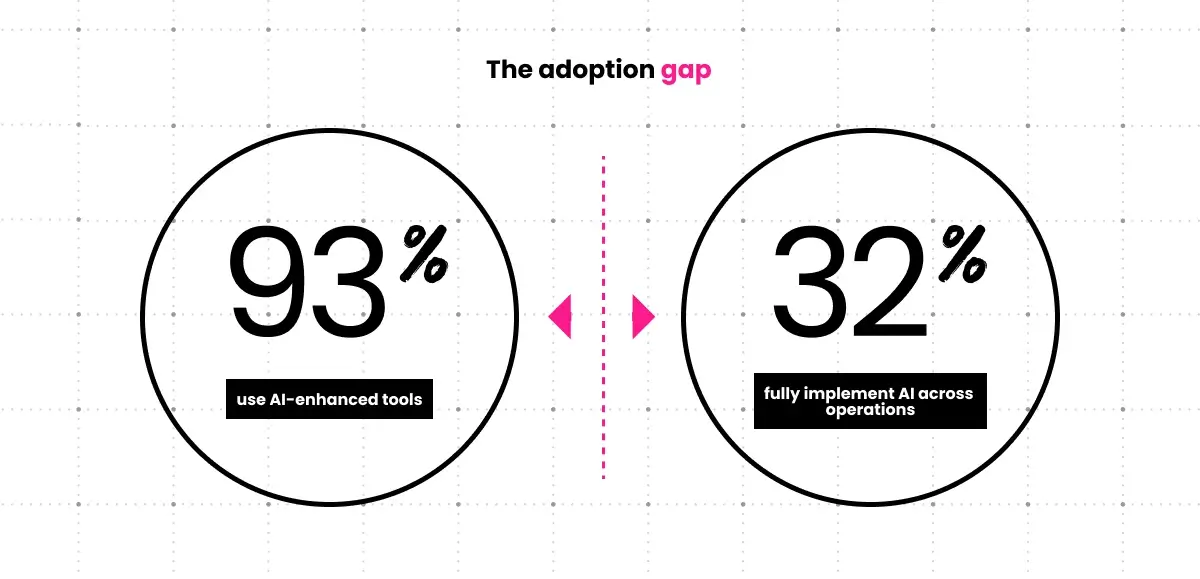
Ninety-three percent of marketers report using AI-enhanced tools. Yet according to Salesforce, only 32% of marketing organizations have fully implemented AI across their operations. The tools exist. Most teams have access to them. The problem is that access doesn’t translate to adoption when nobody has a clear answer to “where do we actually start?”
CMOs at enterprise B2B tech companies aren’t short on access to AI tools. What they’re missing is a clear line from “interesting pilot” to “operational advantage.” Most of the AI content they encounter promises transformation and stops short of what they actually need: which use cases to prioritize, what to realistically expect, and how to move from proof of concept to scale.
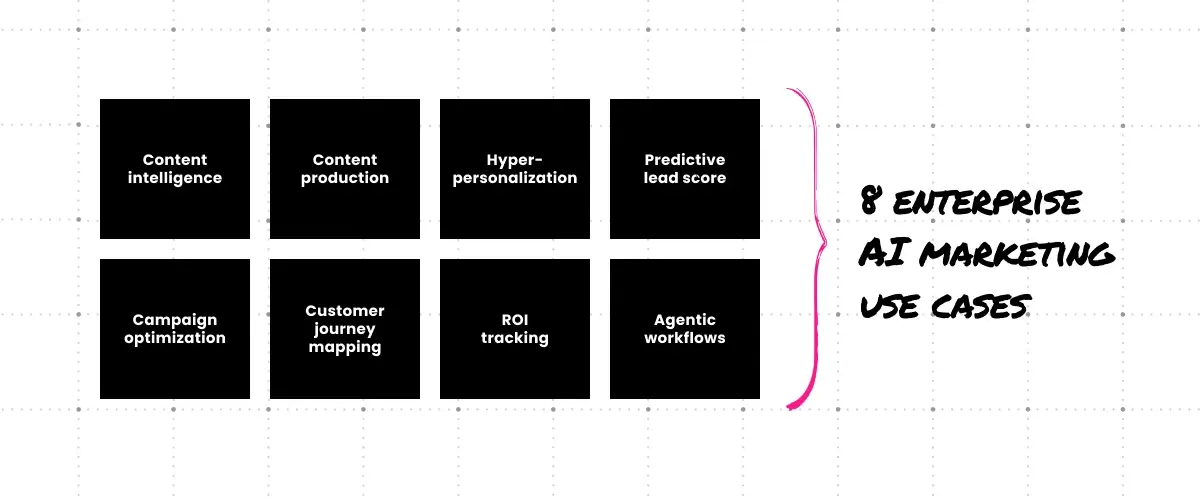
This guide skips the philosophy. It covers eight practical AI marketing use cases, a framework for scaling beyond pilots, and a 90-day action plan CMOs can start on Monday.
Understanding Enterprise AI Marketing vs. Point Solutions
There’s a meaningful difference between adopting an AI tool and building an enterprise AI marketing capability. A point solution automates a single task. Enterprise AI marketing integrates intelligence across your entire marketing operation: content production, lead scoring, campaign optimization, customer experience, and ROI measurement, all as a connected system.
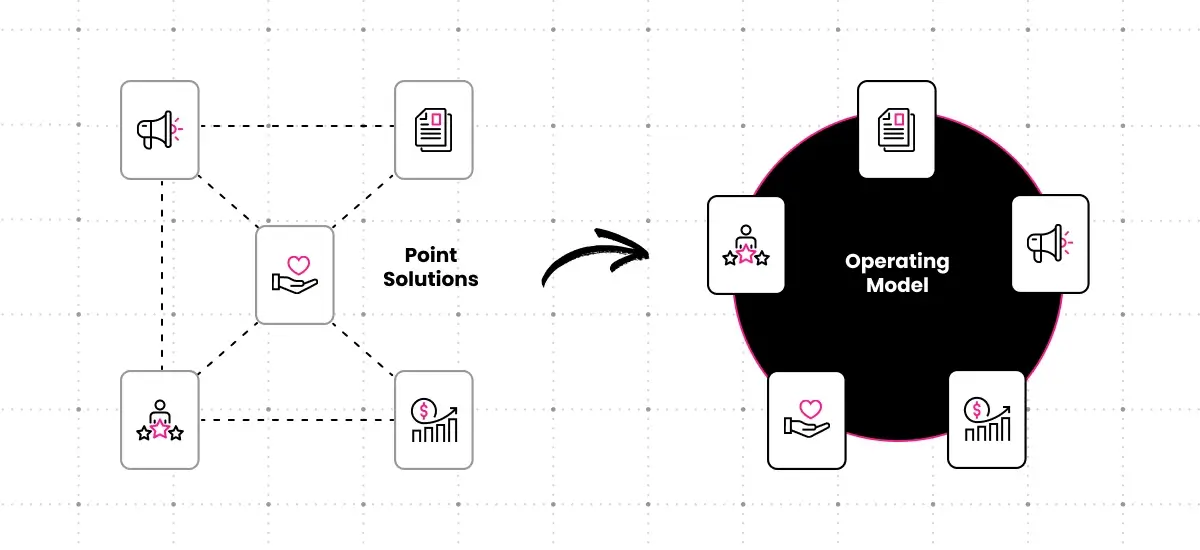
The distinction matters because CMOs who chase individual tools tend to end up with a fragmented stack and modest ROI. The teams that see real, sustained lift treat AI as infrastructure. They align use cases to business goals, establish data foundations, and build governance before scaling. Organizations that build that discipline are the ones where AI stops being a pilot project and starts being an operating model.
Use Case 1: AI-Powered Content Intelligence for Enterprise Marketing Teams
More than half of B2B marketers cite “creating the right content for their audience” as their top challenge, according to Content Marketing Institute’s annual research. The deeper problem: most of that effort goes into production, not into understanding what’s actually working. AI can rebalance that ratio significantly.
Tools trained on your analytics data can surface content decay patterns, identify which pieces drive pipeline (not just traffic), and flag coverage gaps against competitive terms. What previously required hours of analyst time becomes a repeatable, near-real-time process. The highest-ROI applications: audience segmentation analysis, multi-touch attribution, and competitive content gap identification.
When AI handles pattern recognition at scale, your analysts can spend their time on the decisions, not the data gathering. The interpretation still requires human judgment. The volume work doesn’t.
Use Case 2: Generative AI for Scalable Content Production
Enterprise marketing teams face a familiar pressure: produce more content across more channels without proportional headcount growth. Generative AI addresses the volume problem, but only when it’s governed correctly.
The use cases with the clearest ROI are first-draft generation for structured formats (product pages, email sequences, social copy, landing page variants), content localization and adaptation, and SEO-driven briefs that human writers execute against. Treating AI as a production accelerator rather than a content replacement is the operating principle that makes the difference.
Brand voice consistency requires deliberate prompt architecture and a review process that goes beyond spell-check. Clear Digital’s content services team helps enterprise B2B organizations build the workflows that make AI-generated content reliable, not risky.
Use Case 3: Hyper-Personalization and Dynamic Content Delivery
Personalization at scale is no longer operationally out of reach. AI makes it possible to deliver different content to different audience segments based on industry, role, behavioral history, and intent signals, dynamically, without manual curation for each variation.
For B2B tech companies, the highest-value applications are account-based content experiences, adaptive nurture tracks, and website personalization tied to firmographic data. The data requirements are real, and getting them right takes upfront investment. But the results show up in revenue metrics, not just engagement rates.
Clear Digital’s data-driven UX and personalization work has delivered measurable outcomes for enterprise clients, including a 192% conversion increase for [24]7.ai and a 42% session duration increase for Splunk. That kind of lift comes from connecting behavioral signals to content and experience design in a coherent system, not just installing a personalization tool and hoping. More on that approach at Clear Digital’s UX/UI design services.
Use Case 4: Predictive Analytics and Lead Scoring
Traditional lead scoring relies on static rules: job title, form fills, page visits. Predictive AI models train continuously on conversion data to surface behavioral and firmographic signals that actually predict purchase intent, including signals a manual scoring model would never capture.
For enterprise B2B marketing teams, the practical benefit is tighter alignment with sales. When the scoring model is accurate, marketing passes leads with confidence and sales reps spend less time qualifying. The model requires clean CRM data and a feedback loop from sales on close quality. Neither is an insurmountable barrier, but both require upfront honesty about your data’s current state.
The practical starting point: pull your closed-won data, work backward from actual conversions, and let the model surface the signals your rules-based system was never configured to catch.
Use Case 5: Intelligent Campaign Automation and Optimization
AI is most useful across the full campaign lifecycle when it’s applied at the decision layer, not just execution. Predictive budget allocation models recommend channel mix based on historical performance data. Creative testing frameworks run multivariate experiments at a speed and volume no team matches manually. Performance monitoring flags anomalies before they become budget problems.
The highest-performing marketing organizations use AI to compress the feedback loop between campaign launch and optimization. What used to take two to three weeks to diagnose now surfaces in days. For enterprise B2B, where sales cycles are long and campaign windows are narrow, that speed of iteration is a real competitive edge.
One thing worth keeping in mind: AI optimizes toward whatever you tell it to optimize for. Set the wrong targets and the system will hit them efficiently and uselessly. Spend the time upfront defining what success actually means before you build the automation around it.
Use Case 6: AI-Enhanced Customer Journey Mapping and Experience
Customer journeys in B2B tech are long, nonlinear, and involve multiple stakeholders across months of buying activity. AI can analyze behavioral data across touchpoints at a scale traditional journey mapping can’t match, surfacing drop-off patterns, unexpected conversion paths, and intent signals that don’t appear in standard funnel reports.
A more detailed journey map is rarely the point. What matters is knowing exactly where buyers drop off and being able to act on that quickly: a content gap, a retargeting sequence, or a UX change that removes a specific friction point. Clear Digital’s UX and web experience work integrates behavioral data directly into design decisions, so AI insights translate into experience improvements instead of slide decks.
Use Case 7: Real-Time Performance Measurement and AI-Driven ROI Tracking
More than a third of marketing organizations can’t reliably prove ROI. For CMOs, that’s a board-level liability, and one AI is well-positioned to address. Real-time measurement frameworks can connect campaign activity to pipeline and revenue more accurately than manual attribution models, especially in complex B2B buying cycles where a single deal might touch 15 pieces of content across six months.
The practical shift is from periodic reporting to continuous visibility. CMOs with that capability spend less time defending their budget and more time deploying it. Clear Digital’s data and analytics practice helps enterprise marketing teams build the measurement infrastructure that makes AI-powered attribution both possible and defensible to finance.
Use Case 8: Agentic AI and Autonomous Marketing Workflows
The practical difference between generative AI and agentic AI is simpler than it sounds: one responds when you ask it something, the other manages workflows on its own.
This is the frontier of enterprise AI marketing, and it’s closer to production-ready than most CMOs realize. Agentic systems can manage entire marketing workflows autonomously: monitoring SEO performance and queuing content updates, running and adjusting nurture sequences based on live engagement signals, coordinating across channels without human instruction at each step.
The operational implication is significant. According to McKinsey’s “The Economic Potential of Generative AI” report, generative AI and related technologies have the potential to automate work activities that absorb 60 to 70 percent of employees’ time today. If that plays out at scale, the CMO’s role shifts from managing execution to managing outcomes. The teams making that transition intentionally are building a structural advantage over teams that aren’t.
The governance question is the one to solve first. Which decisions require human review? Where does brand risk sit? Which workflows can run autonomously and which need a check-in loop? Getting that model right early prevents the failure modes that tend to make AI adoption stall or reverse.
Agentic AI doesn’t just assist. It acts. The CMOs building governance frameworks today will be the ones scaling autonomous marketing operations tomorrow.
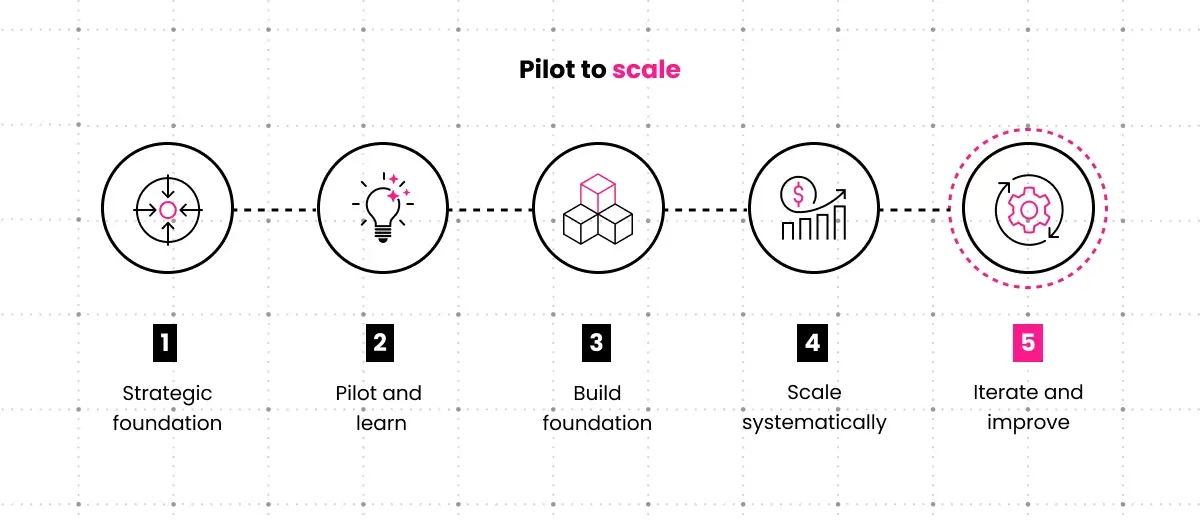
Implementation Framework: Moving from Pilot to Scale
Successful enterprise AI marketing adoption follows a predictable arc. Organizations that scale effectively tend to move through five phases:
- Strategic Foundation: Align AI use cases to specific business goals. Audit your data infrastructure honestly. Establish governance principles before you build anything.
- Pilot and Learn: Run a focused pilot on one use case with clear success metrics. Keep scope small enough that you can learn fast and course-correct without significant cost.
- Build Foundation: Address the data, integration, and process gaps the pilot surfaces. This is where most organizations underinvest, and it’s why most stall.
- Scale Systematically: Expand to additional use cases using the operational model you built in Phase 3. Don’t scale before the foundation is solid.
- Iterate and Improve: Build continuous feedback loops. AI models degrade over time without fresh data and active management. Maintenance is not optional.
The CMOs who skip Phase 3 are the ones who end up stuck in Phase 2 indefinitely.
Common Pitfalls and How to Avoid Them
Most AI marketing initiatives don’t fail because the technology is wrong. They fail because of organizational and strategic mistakes that were preventable.
- Technology before strategy. Buying tools before defining what problem you’re solving is the fastest way to burn AI budget without results.
- Underestimating data requirements. AI is only as good as the data it learns from. Poor data quality produces poor outputs at scale.
- Insufficient human oversight. Automation amplifies whatever direction you set. Without review checkpoints, errors scale alongside efficiency.
- Ignoring change management. Teams resist tools they weren’t involved in selecting. Adoption requires buy-in, not mandates.
- Pilot purgatory. Running the same proof of concept indefinitely because scaling feels risky. At some point, extended indecision is its own cost.
- Ethical and legal blind spots. Data privacy, content disclosure obligations, and bias in scoring models all carry real legal and reputational exposure.
- Forgetting the human element. AI handles execution. Relationship, trust, and strategic judgment still belong to people.
The CMO’s AI Roadmap: Your Next 90 Days
The gap between wanting to implement AI and actually doing it closes with a structured plan. Here’s a practical framework:
Days 1 to 30: Assess and Educate
Audit your current marketing stack and data infrastructure. Identify the three highest-friction areas in your marketing operations. Align your team on what AI can and can’t realistically do. Choose one use case to pilot based on data readiness and potential business impact. Don’t start with the use case you’re most excited about. Start with the one your data is most ready for.
Days 31 to 60: Plan and Pilot
Define measurable success criteria for the pilot before you start. Build or procure the tooling. Run the pilot with a small, accountable team and tight feedback loops. Document what works, what doesn’t, and why.
Days 61 to 90: Learn and Scale
Review pilot results against your defined metrics. Identify what organizational and technical changes would allow you to scale. Build the business case for Phase 2. Commit to a timeline that’s ambitious but not aspirational.
Three months isn’t enough time to build an AI-mature marketing operation. What it is enough time for: an honest read of where your data, your team, and your processes actually stand, plus a specific plan for what comes next.
Conclusion: From AI Experimentation to Competitive Advantage
The CMOs pulling ahead of their peers right now aren’t the ones who ran the most AI pilots. They’re the ones who moved past experimentation and made AI a systematic part of how their teams plan, produce, and measure. That shift requires more than tooling. It requires strategy, governance, clean data, and organizational alignment.
The eight AI marketing use cases in this guide represent a practical starting point. Not all of them are right for every organization at every stage. But the discipline of evaluating them honestly, choosing where to start, and building the infrastructure to scale is what moves AI from an interesting experiment to a reliable part of how your marketing operation works.
Ready to move from AI experimentation to systematic implementation? Let’s talk about where to start.
Get our latest insights in your inbox
8 Criteria for Choosing a B2B Web Redesign Agency
Article
8 Criteria for Choosing a B2B Web Redesign Agency
By Clear Digital on September 15, 2026
Read moreWhat a B2B Website Redesign Requires From Your Team
Article
What a B2B Website Redesign Requires From Your Team
By Clear Digital on September 11, 2026
Read moreHow to Justify a Website Redesign to Your CEO, CFO, or Board
Article
How to Justify a Website Redesign to Your CEO, CFO, or Board
By Clear Digital on September 11, 2026
Read more