
In April 2026, a cybersecurity company issued a formal RFP. The title: “AI-First Agency Partner for Agentic Workflows and Creative Production.”
That phrase did not come from a trend report. It came from a procurement team. The document asked for AI workflow strategy, agentic systems built for content creation and distribution, human-in-the-loop governance, and AI tooling evaluated against enterprise security requirements. The RFP gave proposing agencies two weeks to respond.
You may not have seen that specific document, but if you are a CMO or VP of Digital at a B2B company in 2026, some version of that conversation is coming, if it has not already. The expectation is forming in boardrooms and budget cycles, not just conference keynotes. Most B2B buyers do not yet have a clear definition of what “AI-era agency partner” should mean, or how to tell the difference between an agency that says it and one that actually delivers it.
This article gives you that definition from your side of the table.
AI has already changed how buyers find and evaluate you
B2B buyers are using AI as a starting point for vendor research. According to G2’s 2025 Buyer Behavior Report, 29% of B2B software buyers now start their research in AI tools more often than in Google. A separate 6sense study of nearly 4,000 global buyers puts LLM adoption even higher: 94% report using AI tools at some point during a software purchase. By 2028, Gartner projects that at least 15% of day-to-day work decisions will be made autonomously through agentic AI, up from 0% in 2024.
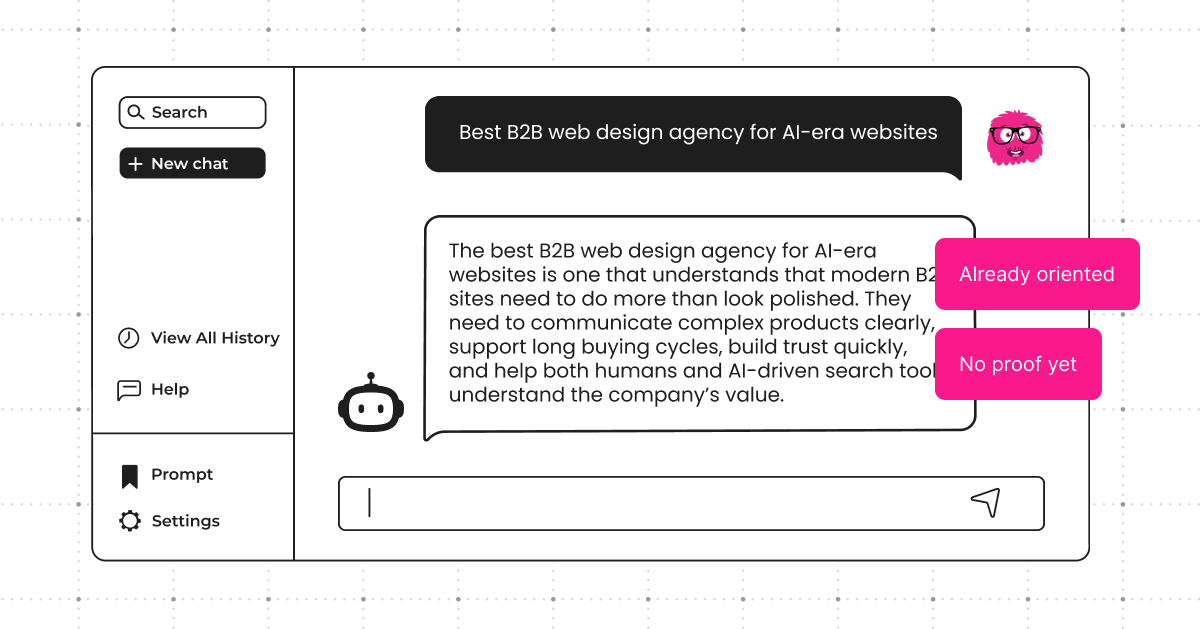
By the time a prospect lands on your page, AI has already given them a summary of your category. It may have told them the questions to ask vendors like you. It may have surfaced a competitor. Your site’s job used to be to inform. Now it has to validate, differentiate, and de-risk what AI has already told them.
Your agency’s job has changed with it. An agency that builds websites without considering how AI reads, cites, and surfaces them is building for a buyer journey that no longer exists. It is also one of the core reasons B2B websites underperform even when traffic looks healthy.
What does “AI-era agency partner” actually mean?
When an agency says they are “AI-first,” the claim lands differently depending on what they mean by it. Some mean they use AI tools to work faster. Some mean they have added AI features to their service list. A smaller number mean they have fundamentally rethought how websites should be built, structured, and maintained given how AI engines now read and cite content.
The last one is what matters for your B2B website.
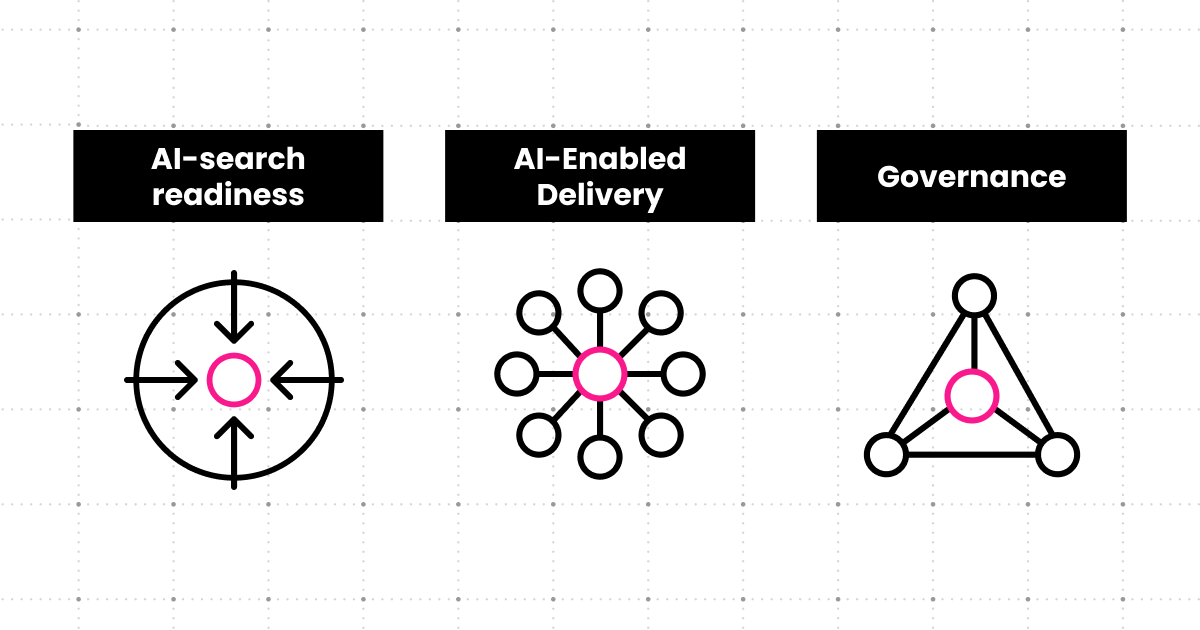
A real AI-era agency partner approaches your website across three dimensions.
AI-search readiness
Your site needs to be structured so AI engines can extract, summarize, and cite it accurately. That means clear content hierarchy, direct answers to questions buyers are asking, structured data where relevant, and content written for humans but readable by machines. The goal is a site organized around how buyers think, not around your org chart.
AI-enabled delivery
This is less about what tools the agency uses internally and more about how those tools change what you get: faster iteration on design and copy, richer data to inform UX decisions, capacity to test and optimize at a pace a purely manual workflow cannot sustain. The right agency uses AI to spend more time on decisions that require human judgment and less time on the ones that do not. For you, that means work ships faster without sacrificing quality, and experimentation becomes something you can actually sustain, not just talk about.
Governance with human accountability
This is the dimension buyers are least likely to ask about and most likely to need. AI generates things. Someone has to own what those things say about your brand. An AI-era agency should have a clear answer to who is accountable when AI-generated content is off-brand, factually wrong, or out of compliance with your security or legal requirements.
Your website is the proof platform now
AI does the summarizing. Your website does the proving, by giving buyers the depth, specificity, and evidence AI cannot.
A buyer reads an AI-generated summary of your company, your category, and your competitors. They arrive on your site already oriented, already skeptical, already holding a mental checklist. The site’s job is to confirm that the AI summary was right to include you, give them something the summary could not (specificity, depth, real evidence of work), and move them toward a decision with less friction.
That shifts what a well-designed B2B website needs to do. It needs to answer the specific questions buyers arrive with, not the generic ones your team assumed they would have. It needs proof that is findable quickly. And it needs to be built in a way that AI engines continue to read it accurately as you update it over time.
That last part is where ongoing optimization matters more than it used to. AI systems do not crawl once and move on. As models and interfaces evolve, how they surface and summarize your content can change too. A site structured for AI-search readiness in 2025 may need attention in 2026 as search behavior shifts. A real AI-era agency builds that into how they work with you from the start, not as an upsell.
For a deeper look at how this plays out at the website level, see what corporate websites need to look like in the age of AI.
Questions worth putting to any agency claiming AI readiness
Most agency pitches will include some version of “AI-powered” or “AI-first.” These questions help you find out what that actually means.
How do you build websites to be cited by AI engines, not just ranked by search engines?
An agency that understands the difference will talk about content structure, answer-ready copy, and semantic clarity. An agency that does not will pivot back to keyword rankings.
Who is accountable when AI-generated output is off-brand or inaccurate?
Listen for a specific answer. “We review everything” is not the same as “our copy director signs off on every piece before it goes to the client.” The first is a process description. The second names a person and a step.
How do you handle AI tooling that touches client data, particularly in regulated or security-conscious industries?
For any company handling sensitive data, this question is not optional. An agency responding to an enterprise cybersecurity RFP has to understand data residency, access controls, and the difference between what AI can touch and what it should not.
What does an AI-era engagement look like month to month?
A project that ends at launch is a different thing than a relationship built around continuous improvement. Ask what the cadence looks like. Ask what gets reviewed and by whom. Ask how the agency measures whether your site is performing in AI search, not just traditional search.
Can you show us a real example of how AI changed the outcome of a project, not just the speed?
If the answer is only about working faster, the agency is using AI for efficiency. That is useful, but it is not the same as using AI to make better strategic decisions on your behalf.
Evaluating agency partners? Let’s talk. If you’re putting together an RFP or figuring out what questions to ask, we’re set up for exactly that conversation.
What a real AI-era engagement looks like in practice
One cybersecurity client’s engagement with us evolved quickly. A conversation that started around motion graphics and creative production became a more complex discussion about how to structure a partnership for a team that had shrunk, was managing multiple internal stakeholders, and needed an agency that could operate as an extension of their team rather than a vendor receiving briefs.
The operating model that came out of those conversations reflects what an AI-era engagement should be: dedicated leads on both sides, a prioritized backlog of work reviewed and updated weekly, flexibility to shift focus as internal priorities change, and quarterly reviews where both sides step back and evaluate whether the work is delivering against its goals.
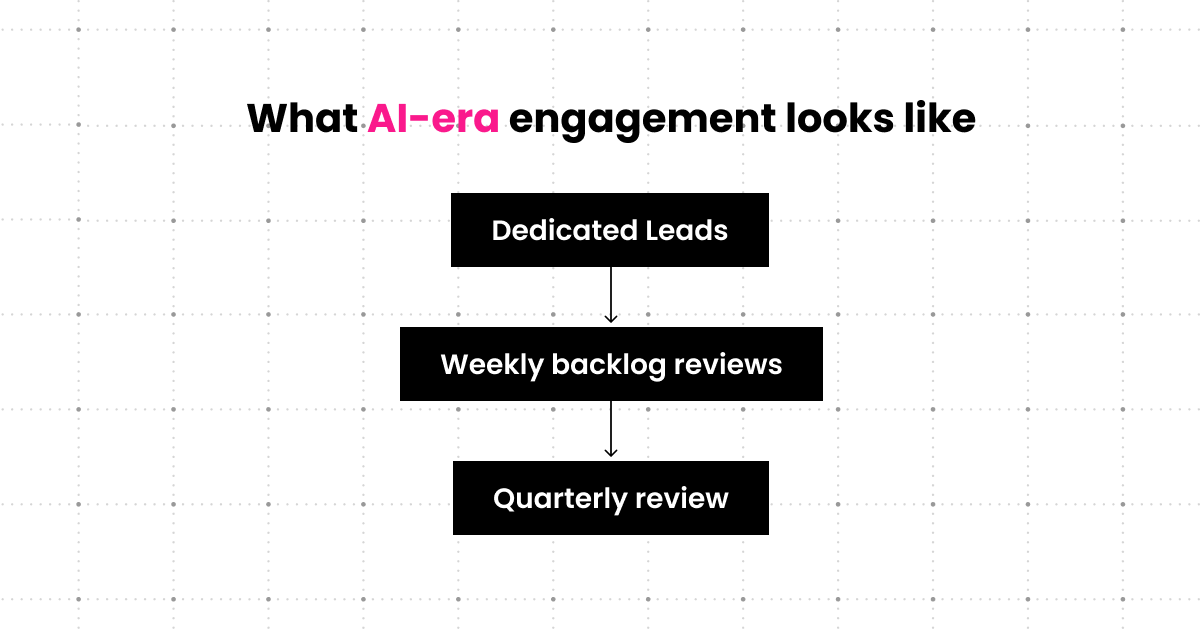
Whether you work with us or another partner, this is the kind of operating model worth looking for. The specifics may vary, but the structure (transparent accountability, regular prioritization cadence, and human oversight at every stage) should not.
AI tools are part of how we run that kind of engagement. They help us move faster on production work so senior thinking goes to decisions that warrant it. They help us structure content for AI-search readiness from the start rather than retrofitting it later. They help us flag when something is drifting from a client’s brand before it reaches review.
The judgment calls stay with people.
The standard is being written in RFPs right now
The buyers furthest along in thinking about AI-era agency partnerships are not waiting for agencies to define the standard. They are writing it themselves, in procurement documents, vendor qualification criteria, and finalist interviews.
Most RFPs are still early drafts of that standard. A good agency will help you refine the criteria into something you can actually measure, not just respond to them.
If you are evaluating agency partners right now, the questions above give you a place to start, and how to evaluate a B2B web design agency gives you a full framework before you sign anything. If you are putting together an RFP, the criteria they point at (AI-search readiness, AI-enabled delivery, human-led governance) are a reasonable framework for what to ask for.
Clear Digital has been inside these conversations. We work with B2B companies navigating this inflection point, with teams stretched thin, internal structures changing, and a website built for a buyer journey that looks different now than it did two years ago.
If you are figuring out what the right partnership looks like for your organization, that is the conversation we are set up to have. Let’s talk.
TL;DR
B2B buyers are starting vendor research in AI engines before visiting websites. By the time they land on your page, AI has already oriented them. An AI-era agency partner helps you build a site that validates what AI has told buyers, answers the specific questions they arrive with, and continues to perform as AI search behavior evolves. When evaluating agencies, ask about:
- AI-search readiness: how they structure your site for AI extraction and citation
- Delivery model: how AI changes what you get, not just how fast they work
- Governance: who is accountable when AI output is wrong or off-brand
- Ongoing optimization: how they measure performance over time, not just at launch
Get our latest insights in your inbox

8 Criteria for Choosing a B2B Web Redesign Agency
By Clear Digital on September 15, 2026
Read more
What a B2B Website Redesign Requires From Your Team
By Clear Digital on September 11, 2026
Read more
How to Justify a Website Redesign to Your CEO, CFO, or Board
By Clear Digital on September 11, 2026
Read more