
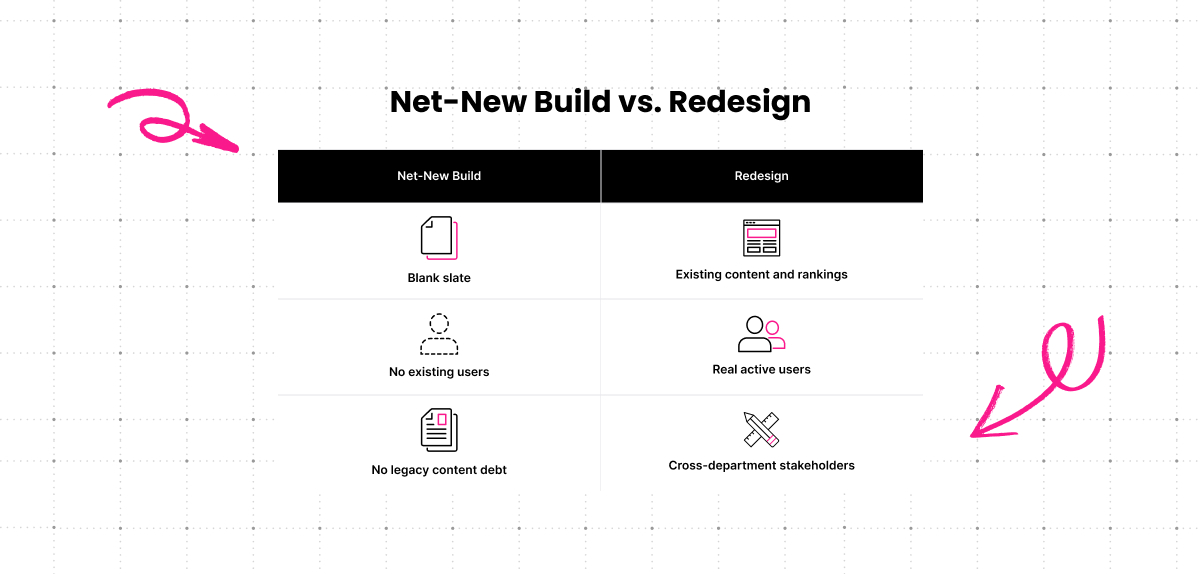
A redesign is not a new build. Your site already has content that ranks, users who rely on it daily, and people across sales, marketing, and IT who each have a stake in what changes. An agency that builds beautiful net-new sites can still get a redesign wrong if they treat your existing site as a blank page instead of a system with history and risk attached.
Redesign or refresh first? Settle that question before you start evaluating agencies. Once you know a redesign is the right call, the criteria below apply specifically to that decision. For a broader agency evaluation framework, our full guide covers the general case. These eight criteria are the redesign-specific layer on top of it.
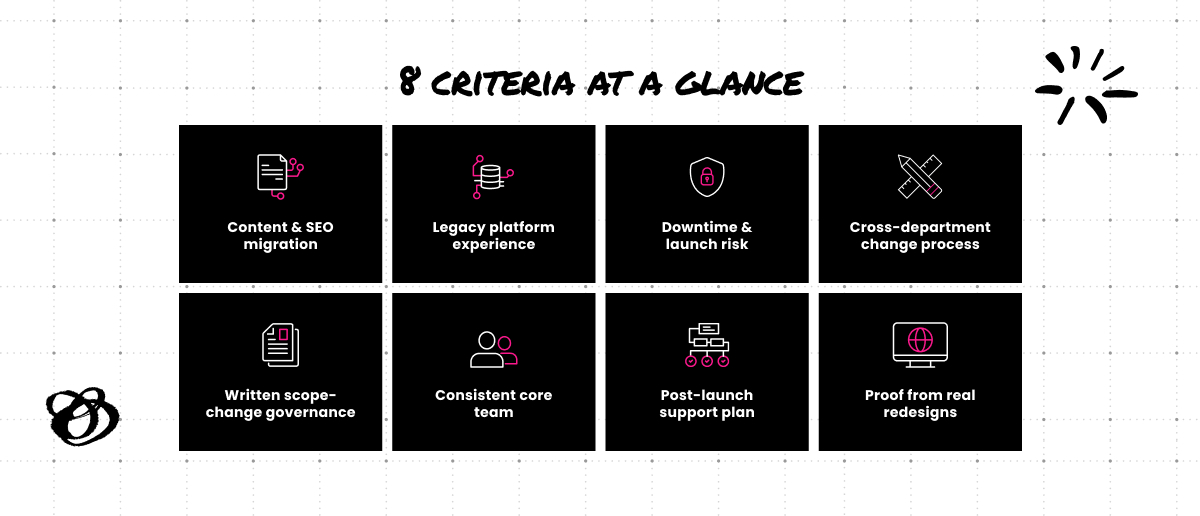
1. A documented content, SEO, and analytics migration plan
Ask any finalist agency to walk you through their migration process before you sign anything. A redesign that quietly breaks URL structure, drops metadata, or fails to redirect ranking pages can cost you months of organic visibility. The agency should be able to name their approach to a content audit, a URL mapping document, 301 redirect testing, and analytics continuity: GA4 events, form tracking, CRM attribution, and consent configuration all need to survive the move intact. Keeping the content that already works is part of that plan, not an afterthought.
2. Direct experience with your specific legacy platform or CMS
Migrating off an outdated CMS is a different skill than building on a modern one from scratch. Ask what platforms they have migrated clients away from, not only what they build on today. An agency that has handled a real migration off your specific system, whether it is a legacy Drupal instance, a heavily customized WordPress build, or an aging custom-built CMS, will have answers ready. An agency that has not will improvise.
3. A clear downtime and launch-risk mitigation approach
Your current site keeps working while the redesign happens. Ask how the agency handles staging, QA, and rollback if something goes wrong at launch. What should be included in a redesign RFP is worth reviewing before you send one out, since this is one of the details finalists most often gloss over.
4. A defined process for managing change across departments
A redesign touches more departments than a net-new build does. Sales has opinions about the site they use in active deals. IT has requirements about security and hosting. Marketing owns the brand and the content calendar. The agency’s process needs a defined way to collect input from each group, resolve conflicting priorities, and keep the project moving without stalling on internal disagreement. Preparing your internal team before the project starts makes this easier on your side too.
5. Written governance for scope changes
Ask what happens when scope changes mid-project, because on a redesign, it usually does. Someone on your team uncovers something in the existing site nobody expected, or raises a new requirement in month two. The right answer includes a documented change-control process, a written cost and timeline impact assessment before any scope change is approved, named approvers, and a regular status cadence you can count on rather than checking in only at milestones.
6. A consistent core team from workshop through launch
Ask who specifically will work on your project, and confirm that team stays intact through launch. Clear Digital keeps a senior strike team on every engagement, a project manager, strategist, creative lead, and tech lead, with no B-team handoff after the deal closes and no pitch-team-to-delivery-team swap.
7. A post-launch support and optimization plan
A redesign launch is a milestone along the way, not the end of the work. Ask for the agency’s plan for the first 30 and 90 days: pre-launch performance benchmarks and post-launch reporting against Core Web Vitals, indexation and crawl health, conversion tracking, and priority organic pages. That plan should exist in writing before you sign, with named owners and dates attached.
8. Proof from other redesigns specifically, not only net-new builds
A portfolio full of net-new sites tells you the agency can design well. It doesn’t tell you whether they can handle the complexity of an existing site with real users, real content debt, and real people across departments who have to sign off. Ask a finalist agency to walk you through a redesign case study in detail: what existed before, what they preserved, what they changed, and what made it hard.
Put these criteria to work
Run any finalist through these eight questions before you sign a contract. The agencies that answer all eight with specifics, dates, named owners, and real examples are the ones equipped to run a redesign.
See how this fits into a full evaluation with our agency evaluation guide, or explore Clear Digital’s approach to web design.
Get our latest insights in your inbox

What a B2B Website Redesign Requires From Your Team
By Clear Digital on September 11, 2026
Read more
How to Justify a Website Redesign to Your CEO, CFO, or Board
By Clear Digital on September 11, 2026
Read more
Your website is no longer the front door. The LLM is.
By Bernadette Blanchard on September 3, 2026
Read more