AEM vs WordPress: How Global Enterprises Choose the Right CMS for Scale, Governance, and Agility

AEM and WordPress solve different problems. AEM brings structure, governance, and Adobe ecosystem depth to organizations managing 50+ digital properties across regions. WordPress brings speed, flexibility, and cost efficiency to teams that need to move fast without burning through budget on specialized talent.
Most enterprise teams researching this comparison are already leaning one direction. The question is whether the numbers and operational reality confirm it. After 25+ years implementing both platforms for B2B organizations, here is what the decision actually looks like in practice.
Market Reality: AEM holds approximately 0.1% of the CMS market. WordPress powers roughly 42% of all websites and close to 60% of sites using a known CMS. Market share alone does not tell the full story — these platforms serve fundamentally different enterprise needs.
Choosing the right Content Management System (CMS) or Digital Experience Platform (DXP) has become one of the most consequential strategic decisions for global enterprises. Your CMS is no longer just a publishing tool—it is the operational foundation that governs how efficiently your digital teams work, how consistently your brand shows up across regions, and how well your organization delivers experiences that meet modern customer expectations.
For many enterprise organizations, the conversation often narrows to two leading platforms: Adobe Experience Manager (AEM) and WordPress. These two systems occupy opposite ends of the CMS spectrum, offering very different approaches to governance, flexibility, scalability, cost, maturity requirements, and long-term digital strategy.
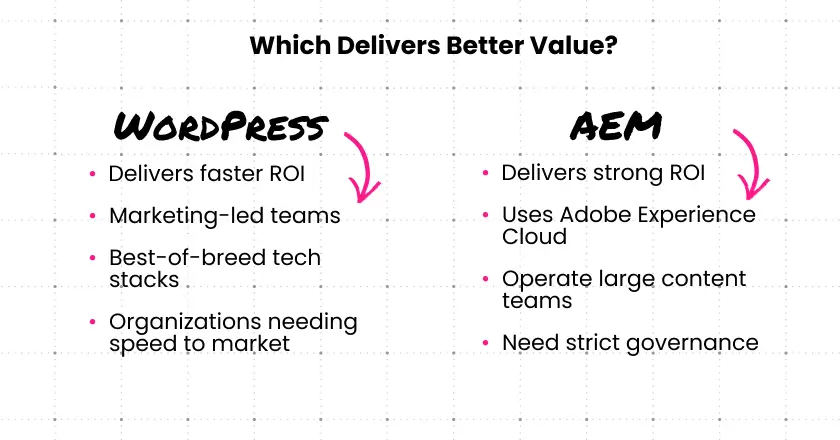
This article offers a clear, advisory perspective to help enterprise leaders choose the right platform for their organizational structure, digital ambitions, and operating realities.
AEM vs WordPress: Head-to-Head Comparison
| Factor | Adobe Experience Manager (AEM) | WordPress |
| Annual Licensing | $100K–$500K+ | $0 (open-source) |
| Total 3-Year TCO | $750K–$2M+ | $50K–$300K |
| Implementation Time | 6–12 months | 2–6 months |
| Developer Talent Pool | Limited (Java, JCR, HTL specialists) | Massive (global PHP/JS community) |
| Hosting Control | Adobe-managed cloud | Full flexibility (WP Engine, Kinsta, AWS, etc.) |
| Best For | Multi-brand, multi-region enterprises; regulated industries | Fast-moving marketing teams; cost-conscious enterprises; headless implementations |
| Learning Curve | Steep (requires training) | Low (intuitive for marketers) |
| Governance | Built-in workflows & permissions | Plugin-based (requires configuration) |
| Personalization | Adobe Target integration | Third-party tools (Optimizely, Dynamic Yield) |
| Vendor Lock-in | High (Adobe ecosystem) | None (portable codebase) |
| Migration Path Away | Complex, costly, long timeline (6–18 months) | Straightforward, portable codebase, open data |
| Modern Deployment Model | AEM Cloud Service (AEMaaCS), Adobe-managed | WP Engine, Kinsta, Pantheon, AWS (full flexibility) |
Why Choosing the Right Enterprise CMS Matters More Than Ever
An enterprise CMS affects every aspect of digital operations:
- Speed to market: How fast can teams publish?
- Global governance: How consistently can you manage multi-region content?
- Personalization: Can you deliver meaningful, targeted experiences?
- Security: Can the platform enforce enterprise-grade controls?
- Scalability: Will the CMS grow with your team’s needs—not against them?
- Team efficiency: Does it empower marketers or slow them down?
Today’s enterprise websites function less like static marketing assets and more like living ecosystems—content hubs, personalization engines, communication platforms, and conversion tools all at once. As expectations grow, the CMS becomes a lever for organizational velocity or a bottleneck that slows progress.
The Rising Complexity of Global Digital Ecosystems
Global organizations manage dozens—sometimes hundreds—of digital touchpoints. These include brand sites, regional sites, campaign microsites, landing pages, support hubs, product documentation, internal portals, and more. Without a CMS capable of enforcing structure, consistency, and governance, digital ecosystems become fragmented quickly.
How CMS Architecture Impacts the Business
Your CMS architecture influences:
- How your team collaborates
- The speed at which you can deploy new digital experiences
- The integrity and consistency of your brand
- The performance of your digital properties
- The cost and sustainability of your operational model
A misaligned CMS creates operational debt. The right CMS accelerates execution
for years.
AEM Overview — The Enterprise-Grade Digital Experience Platform
Adobe Experience Manager is one of the most powerful enterprise DXPs available today. AEM integrates CMS functionality, Digital Asset Management (DAM), workflows, permissions, personalization, and multi-site orchestration into a single platform. It is intentionally built for structured, large-scale organizations whose digital needs extend far beyond page publishing.
What AEM Is Designed to Solve
AEM is engineered for enterprises that operate across:
- Multiple regions or countries
- Multiple brands or sub-brands
- Highly regulated industries
- Strict content approval processes
- Large teams with distributed content responsibilities
- Complex localization workflows
- Personalization programs across customer journeys
It brings order, structure, and rigor to digital ecosystems that would otherwise be difficult to govern.
Strengths of AEM for Global Enterprise
AEM excels in several key areas:
Governance & Workflows
AEM enables granular control over who can publish what, where, and when. This is essential for enterprises balancing autonomy with brand consistency.
DAM Integration
AEM Assets centralizes image, video, and document management. This improves asset reuse and reduces versioning issues across markets.
Multi-Site Management
Enterprises can manage a global website architecture through master templates and content inheritance, reducing maintenance overhead.
Personalization
AEM integrates natively with Adobe Target and Adobe Analytics, allowing sophisticated segmentation and personalized content delivery.
But there’s an important caveat—one that many organizations underestimate.
“Most organizations overestimate their personalization maturity. AEM is powerful, but only if your teams can actually use the tools.”
— Valod Amirkhanian, Director of Technology, Clear Digital
AEM offers best-in-class personalization, but only organizations with the data, content volume, governance models, and operational rigor can unlock its full value.
When AEM Delivers Maximum ROI
AEM becomes a high-value investment when:
- Your marketing and digital teams are large or distributed
- Governance is critical to brand or regulatory compliance
- You adopt Adobe Analytics, Target, or Marketo
- You require sophisticated localization
- You have the resources to support specialized roles and DevOps
When implemented correctly, AEM becomes a unifying force across global digital operations.
AEM verdict: The right fit for large, complex organizations that can staff it, fund it, and actually use its full feature set. For everyone else, the overhead outweighs the capability.
WordPress Overview — The Flexible, Fast, and Cost-Efficient CMS
WordPress is the world’s most widely used CMS, powering more than 43% of the web. While often viewed as an SMB tool, enterprise WordPress implementations have become increasingly sophisticated—especially with modern development practices, headless architectures, component-based design systems, and enterprise managed hosting.
Why WordPress Dominates the CMS Market
WordPress thrives because:
- It offers unmatched flexibility
- It enables extremely fast development
- It has no licensing fees
- It supports a massive plugin and integration ecosystem
- It is easy for marketing teams to use
- It is backed by the world’s largest pool of developers
WordPress provides freedom and speed—two things that enterprise teams often need but lack.
WordPress verdict: The stronger default choice for most B2B enterprises. The platform handles complexity well when the architecture is right. The limiting factor is almost never WordPress.
Enterprise Use Cases and Scalability
WordPress is particularly strong for:
- Corporate websites
- Multi-language marketing sites
- Campaign microsites
- Landing pages
- Knowledge and resource hubs
- Organizations wanting headless CMS capabilities
- Enterprises using a best-of-breed martech stack
While WordPress does not enforce governance as strongly as AEM, it scales extremely well with the right architecture and operational guardrails.
The Truth About WordPress Security
WordPress’s security reputation is misunderstood. The core platform is secure; vulnerabilities typically arise from poor hosting, weak governance, or unvetted plugins.
“AEM is much more secure out of the box, while WordPress can be hardened to enterprise-grade security with disciplined implementation, hosting, and governance.”
— Valod Amirkhanian, Director of Technology, Clear Digital
Enterprises using WordPress often rely on hardened hosting environments, code reviews, automated patching, and headless front-ends to reduce risk.
Cost & Total Cost of Ownership (TCO) Comparison
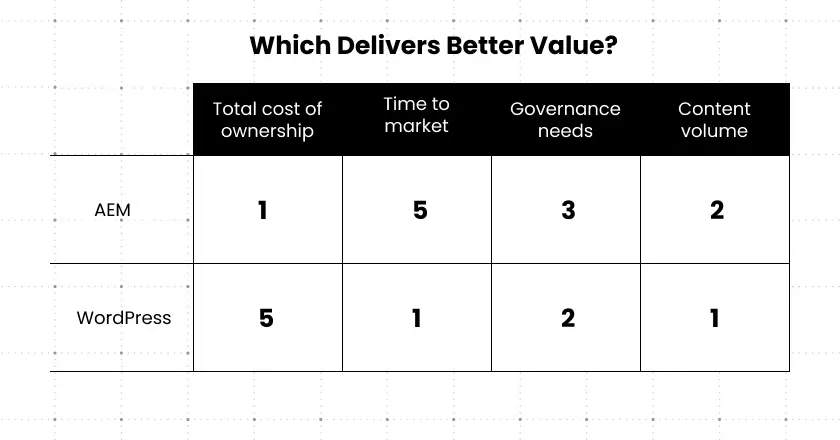
Cost is one of the clearest differentiators between AEM and WordPress. Understanding the full financial picture requires looking beyond licensing to implementation, talent, hosting, and ongoing maintenance.
Detailed Cost Breakdown
| Cost Category | AEM | WordPress |
| Annual Platform Licensing | $100K–$500K+ | $0 |
| Implementation (Initial Build) | $500K–$2M+ | $50K–$300K |
| Annual Hosting | Included in license (Adobe Cloud) | $12K–$60K (enterprise managed) |
| Annual Development/Maintenance | $150K–$400K (specialized talent) | $50K–$150K |
| Developer Day Rate | $1,200–$2,000+ | $400–$800 |
| Estimated Year 1 All-In | $600K–$1.5M+ | $62K–$360K |
| 3-Year Total Cost of Ownership | $750K–$2M+ | $50K–$300K |
Cost verdict: The numbers are not close. Unless AEM’s governance and Adobe ecosystem depth are core to your digital operations, it is difficult to justify the cost gap.
AEM Licensing and Operational Costs
AEM is a premium enterprise platform with:
- High licensing fees ($100K–$500K+ annually depending on tier and usage)
- Specialized development talent (Java, JCR, HTL expertise required)
- Dedicated DevOps requirements
- Higher implementation timelines (6–12 months typical)
- Ongoing system maintenance costs
For enterprises needing centralized control and complexity management, the investment is often justified.
WordPress TCO Advantages
WordPress offers:
- Zero licensing cost
- Lower development costs (larger talent pool, lower rates)
- Faster build timelines (2–6 months typical)
- The freedom to scale infrastructure elastically
- Flexibility to choose best-of-breed tools
This is why most enterprises exploring cost efficiency choose WordPress.
“Licensing is the biggest cost difference. Specialized teams are the second.”
— Valod Amirkhanian, Director of Technology, Clear Digital
Industry analyses and Clear Digital’s implementation experience point in the same direction: enterprise WordPress deployments typically run 50-70% lower in total cost over three years than comparable AEM implementations. The gap widens the deeper the organization is tied into Adobe’s broader ecosystem. These figures are directional estimates based on scope and deployment model.
Time-to-Market and Implementation Complexity
Speed matters—especially for marketing-led organizations.
Why AEM Timelines Are Longer
AEM’s strength—structure, governance, and workflow—is also what extends its implementation timeline. Complex configurations, integrations, DAM setup, and multi-site inheritance require careful planning.
“AEM requires approximately 3–5× the effort and timeline of WordPress builds.”
— Valod Amirkhanian, Director of Technology, Clear Digital
This has major implications for organizations with aggressive go-to-market timelines.
Time-to-market verdict: If your organization needs to launch, iterate, or pivot within a 6-month window, AEM is not a realistic option. This is not a criticism of the platform — it is just how the architecture works.
WordPress and Marketing Agility
WordPress shines when:
- Market conditions change quickly
- Brands launch campaigns frequently
- Teams need to publish without heavy approvals
- Speed to deployment is a competitive advantage
Fast-moving enterprises often gravitate toward WordPress for this reason alone.
Scalability, Governance, and Organizational Readiness
Both CMS platforms scale—but only with the right operating models behind them.
AEM’s Governance-Driven Scalability
AEM scales through structure. Its ability to cascade templates, manage inheritance, control roles, and enforce brand consistency makes it ideal for complex multi-site ecosystems.
WordPress’s Flexibility-Driven Scalability
WordPress scales technically with ease—especially with headless architectures, CDN layers, and enterprise hosting. However, scalability depends on governance discipline.
“AEM scales beautifully—until the team behind it can’t. WordPress scales
beautifully—until governance breaks.”— Valod Amirkhanian, Director of Technology, Clear Digital
In both cases, organizational maturity—not platform capability—is often the limiting factor.
Scalability verdict: Both platforms scale. The question is what breaks first — the technology or the team behind it. Invest in governance models before investing in platform upgrades.
Decision Framework: Which CMS Is Right for Your Enterprise?
Use this framework to evaluate which platform aligns with your organization’s needs, resources, and strategic priorities.
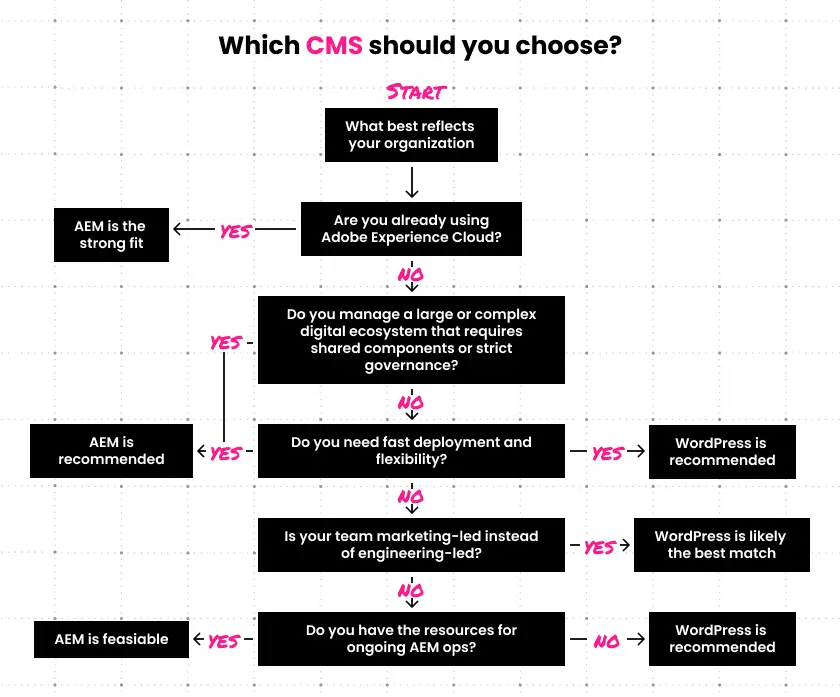
If you are already on AEM and re-evaluating, the same framework applies. The question shifts slightly: it is less about which platform is better and more about whether the operational overhead of staying on AEM is still returning measurable value.
| Your Situation | Choose AEM If… | Choose WordPress If… |
| Annual digital budget | $500K+ available | Under $300K |
| Number of sites/regions | 50+ sites, 10+ regions | 1–25 sites |
| Governance requirements | Strict approval workflows required | Flexible, team-driven |
| Adobe ecosystem | Already using Analytics, Target, Marketo | Using non-Adobe tools |
| Time to launch | 12+ months acceptable | Need to launch in 2–6 months |
| Development team | Can hire/retain AEM specialists | Prefer widely available talent |
| Personalization maturity | Sophisticated, data-driven programs | Getting started or using third-party |
| Regulatory/compliance needs | Financial services, healthcare, pharma | Standard enterprise requirements |
Quick Decision Guide
Choose AEM when:
- You’re managing 50+ websites across 10+ countries
- You’re already invested in Adobe Marketing Cloud
- Regulatory compliance requires strict content governance
- You have budget for $500K+ initial investment and $200K+ annually
- Your digital maturity supports advanced personalization
Choose WordPress when:
- Speed to market is critical for competitive advantage
- You need flexibility to integrate best-of-breed tools
- Budget constraints require cost efficiency
- Your team values autonomy over centralized control
- You want access to the largest developer talent pool
- You’re exploring headless architecture or modern JAMstack
Frequently Asked Questions
Is WordPress secure enough for enterprise use?
Yes. WordPress core is secure and regularly audited. Enterprise security issues typically stem from poor plugin management, inadequate hosting, or lack of governance, not the platform itself. With enterprise managed hosting (WP Engine, Pantheon), code review processes, and proper security plugins, WordPress meets enterprise security requirements for most industries.
How much does AEM actually cost?
AEM licensing typically ranges from $100K to $500K+ annually, depending on your tier and usage. However, the true cost includes implementation ($500K–$2M+), specialized developer talent ($1,200–$2,000/day), and ongoing maintenance. Three-year TCO commonly exceeds $1M for mid-size implementations.
Can WordPress handle multi-site, multi-language deployments?
Absolutely. WordPress Multisite and plugins like WPML or Polylang support complex multi-language, multi-region deployments. Major enterprises including Sony, Microsoft, and The Walt Disney Company use WordPress for global properties. The key is proper architecture and governance planning.
What’s the implementation timeline difference?
AEM implementations typically take 6–12 months for enterprise deployments. WordPress implementations typically take 2–6 months. AEM requires approximately 3–5× the effort due to its complexity, governance setup, and integration requirements.
Is AEM only worth it if we use other Adobe products?
Not exclusively, but the ROI improves significantly with Adobe ecosystem adoption. AEM’s native integrations with Adobe Analytics, Target, and Marketo create compounding value. If you’re not using—or planning to adopt—other Adobe tools, you may not realize the full platform value.
Can we migrate from AEM to WordPress (or vice versa)?
Yes, though migrations require careful planning. AEM-to-WordPress migrations are common for organizations seeking cost reduction or increased agility. WordPress-to-AEM migrations typically occur when governance needs outgrow WordPress’s native capabilities. Both require content mapping, URL strategy, and change management.
What about headless CMS options?
Both platforms support headless architecture. WordPress offers robust REST API and GraphQL support via WPGraphQL. AEM provides headless capabilities through Content Services and GraphQL APIs. For pure headless needs, also consider purpose-built platforms like Contentful, Sanity, or Strapi.
How do I find qualified AEM developers?
AEM developers require Java, JCR (Java Content Repository), and HTL (HTML Template Language) expertise—a significantly smaller talent pool than WordPress. Expect to pay premium rates ($1,200–$2,000+/day) and plan for longer hiring timelines. Many enterprises work with Adobe partner to supplement internal teams.
When does it make sense to migrate from AEM to WordPress?
The business case for migrating off AEM typically builds around three factors: licensing and maintenance costs that have become difficult to justify, editorial teams that find the platform slow relative to their publishing pace, and a martech stack that has moved away from Adobe-native tools.
Worth noting: WordPress is not always the natural landing spot. As Valod Amirkhanian, Director of Technology at Clear Digital, puts it: “If you’re not tied into Adobe’s broader ecosystem and the licensing cost is becoming hard to justify, that’s when migration starts to make sense. But if your infrastructure runs deep on Adobe tools, the decision is more complicated than just switching CMS.”
Migration timelines typically run 4-8 months depending on site complexity, content volume, and how deep the Adobe dependencies go. Clear Digital has managed migrations in both directions.
Making the Right Choice for Your Organization
The AEM vs WordPress decision isn’t about which platform is “better”—it’s about which platform aligns with your organization’s governance requirements, budget realities, and digital velocity needs.
AEM is the right choice for Fortune 500 enterprises with complex multi-brand, multi-region requirements, substantial budgets, and deep Adobe ecosystem investments. It brings order to complexity.
WordPress is the right choice for enterprises prioritizing speed, flexibility, and cost efficiency—especially those with strong internal governance cultures and best-of-breed martech strategies.
The most important factor isn’t the platform—it’s your organization’s readiness to use it effectively.
Need Help Choosing?
Clear Digital helps enterprises evaluate, implement, and optimize both AEM and WordPress. Contact us for a strategic CMS assessment tailored to your organization’s needs.
Let’s talk
Get our latest insights in your inbox

8 Criteria for Choosing a B2B Web Redesign Agency
By Clear Digital on September 15, 2026
Read more
What a B2B Website Redesign Requires From Your Team
By Clear Digital on September 11, 2026
Read more
How to Justify a Website Redesign to Your CEO, CFO, or Board
By Clear Digital on September 11, 2026
Read more