
AI experimentation has become the new performance metric in B2B marketing. Boards want updates. CEOs expect visible wins. Teams are told to move fast and “show something” on AI.
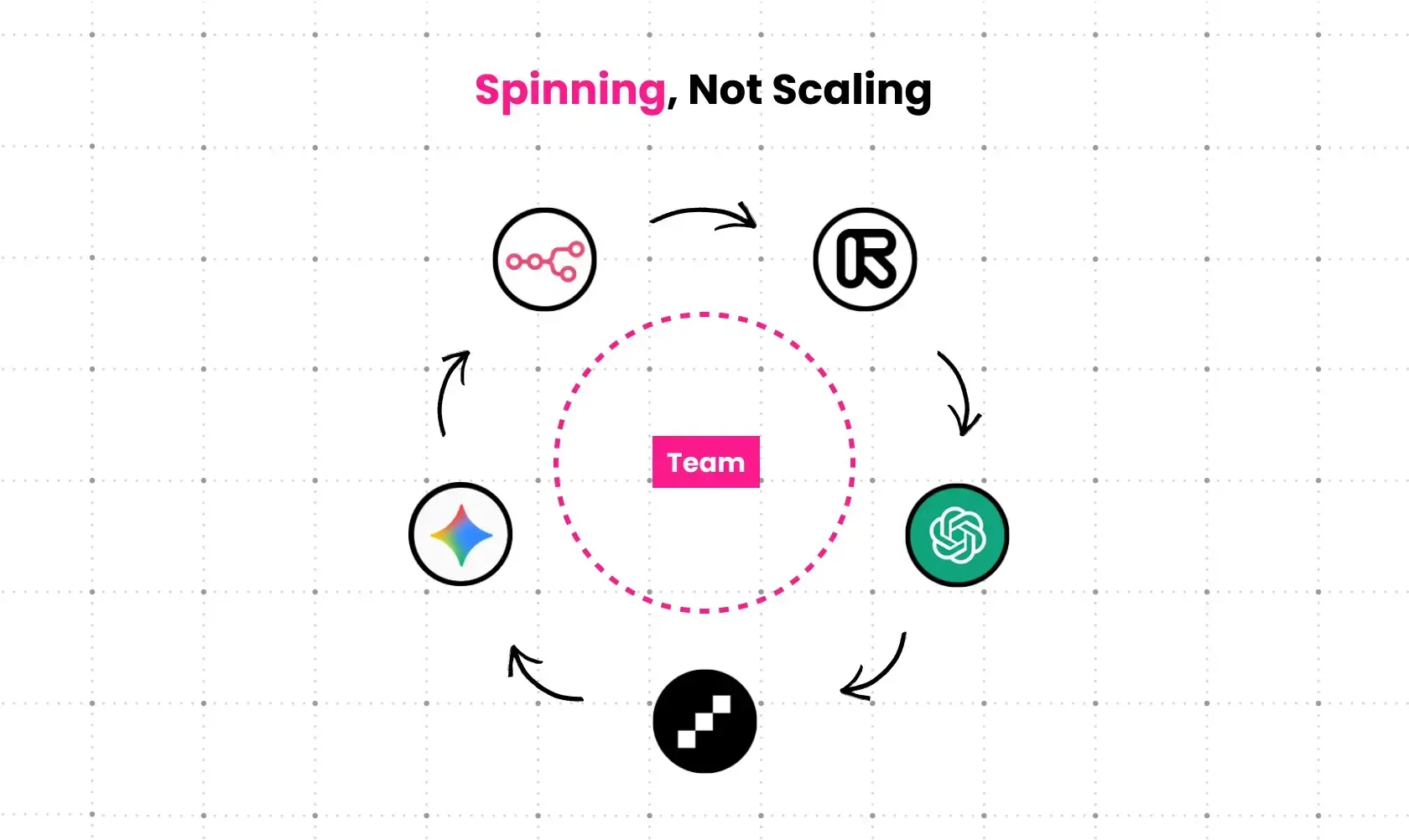
From the outside, that looks like momentum. Inside the organization, it often feels like spinning.
Across our client base, we see teams pouring time, budget, and attention into AI initiatives, yet very few can point to sustained impact on their website, content, or digital experience. The problem is rarely a lack of tools or ambition. More often, the organization is not set up to turn AI into reliable performance.
The AI Mandate Problem
For most B2B marketing leaders I talk to, AI did not start as a carefully defined strategy. It showed up as a directive.
The questions sound familiar. What is our AI strategy. How are we using AI on the website. How do we look next to competitors.
The pressure is real. The guidance usually is not.
Most AI mandates arrive without clear outcomes, shared ownership, or agreed-upon success metrics. Budgets are loosely assigned. Timelines are urgent but vague. Progress is expected even when alignment is missing.
So teams do the reasonable thing. They explore tools. They stand up pilots. They test AI-generated content, personalization, chat, and automation across the digital experience. Activity spikes quickly.
From a distance, this reads as momentum. Inside, it feels fragmented and fragile.
When expectations are high and direction is thin, experimentation becomes the safest response. It lets teams show action without locking into decisions that are hard to unwind. Over time, experimentation stops being a phase and quietly turns into the operating model.
You end up with organizations that are very busy with AI and not meaningfully better.
Why Experimentation Becomes the Default
Experimentation is attractive because it creates visible motion. New tools can be evaluated in weeks. Vendor demos promise fast wins. Pilots produce outputs that look impressive in isolation.
Industry data reflects the pattern. Many B2B marketing teams now use generative AI regularly, especially for content and creative work, but far fewer have embedded AI into repeatable workflows that drive consistent outcomes. The gap between “we are using AI” and “AI is how we operate” stays wide.
The root cause is structural, not inspirational.
Without a shared framework for how AI fits into existing systems, decisions are made tool by tool. Each platform solves a narrow problem. Collectively, they add complexity faster than they add capability.
The symptoms are easy to spot:
- Multiple AI tools producing overlapping or inconsistent outputs
- Faster content creation paired with weaker governance and measurement
- Personalization efforts disconnected from any broader experience strategy
- Teams spending more time managing tools than improving performance
Experimentation is a useful way to learn. It is a poor way to run an operation.
The Enablement Gap
Most stalled AI initiatives trace back to a more basic issue. The organization is not set up to support them.
Operational AI needs more than model access or an enterprise license. It needs clear systems for how work moves, who owns what, and how quality is measured over time.
The cracks show up quickly.
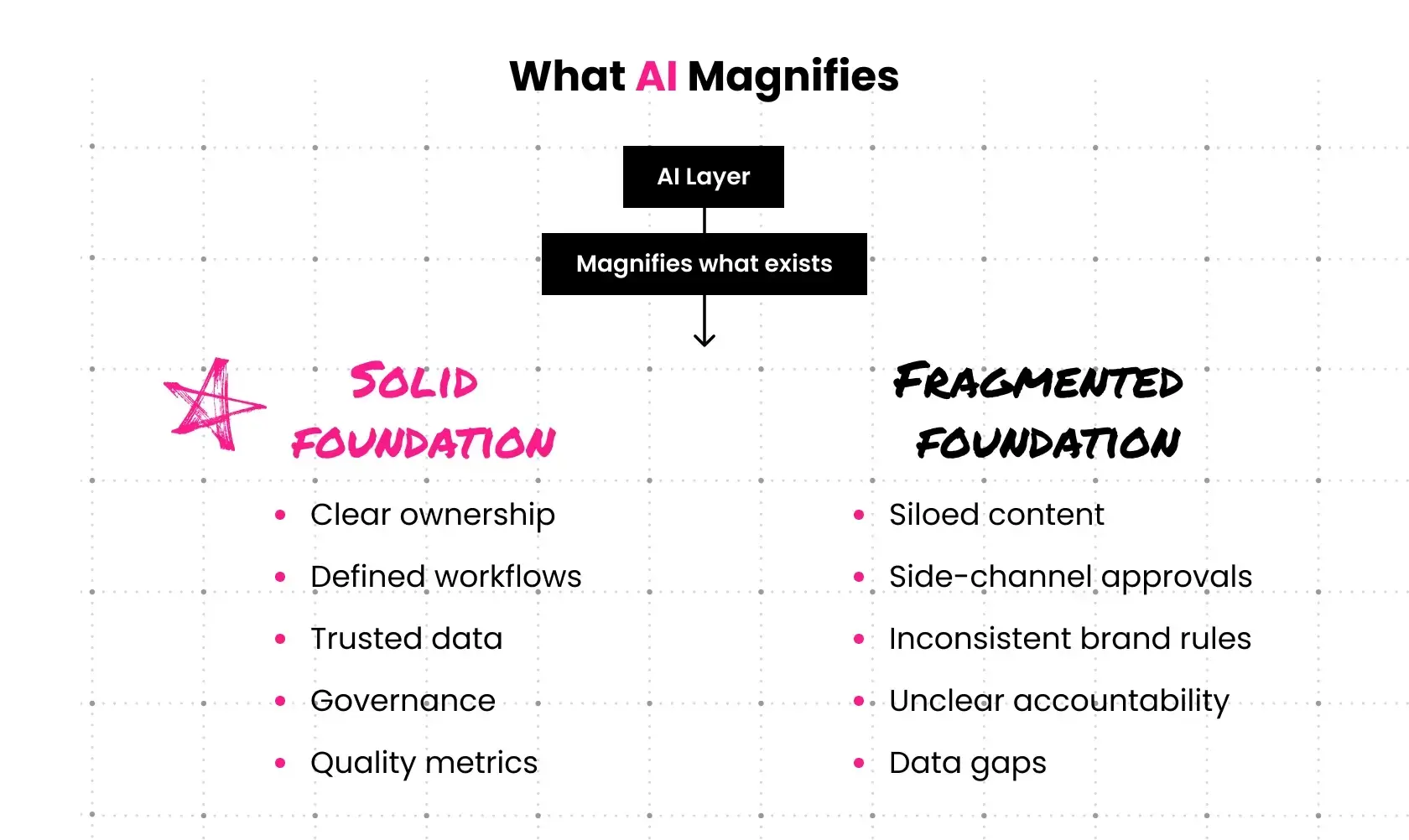
Content lives in different systems with different rules, so AI-generated assets do not line up with the brand or with each other. Data exists, but it is hard to query or trust. Workflows rely on side-channel approvals and one-off exceptions. No one is quite sure who is accountable when an AI output goes live and something is wrong.
In that environment, adding more tools does not create leverage. It just creates more moving parts.
In my experience, AI tends to magnify whatever is already there. When systems and governance are solid, it helps teams move faster in the right direction. When things are fragmented, it multiplies inconsistencies and rework.
That is why so many teams see early speed gains flatten out. Without a stronger foundation, AI increases volume, not value. You get more stuff, not more performance.
Where AI Quietly Breaks Down on B2B Websites
The corporate website sits at the intersection of brand, content, demand, and technology. It is also where expectations for AI are highest.
Personalization, conversational interfaces, and dynamic content all depend on structured content, connected data, and clear performance goals. When those pieces are shaky, the website is the first place AI struggles.
On the surface, it shows up as choppy experiences and hard-to-explain results. Underneath, it looks like this:
- Personalization without structure. A prospect lands on a homepage tailored to their industry but sees case studies from the wrong segment because the data model never accounted for companies that span multiple verticals.
- Content generation without governance. Case studies are auto-generated on the right template but in a tone nobody recognizes as the brand because “on brand” was never codified in a way an AI system can use.
In each case, the AI is doing exactly what it was asked to do. The surrounding systems simply were not ready for it.
If the content model is inconsistent, AI will surface that inconsistency faster. If decision rules are fuzzy, AI will make more fuzzy decisions, just at a higher volume.
From the outside, it looks like “AI did not work.” In practice, the organization asked it to operate on top of foundations that were not ready.
Many teams run into the same constraints. Legacy architectures. Rigid templates. Disconnected content systems that were never designed for adaptive, AI-enabled experiences.
If this sounds familiar, two related pieces go deeper on the website side:
- What Corporate Websites Need to Look Like in the Age of AI
- How to Improve Your B2B Website Effectiveness in 90 Days
The website is usually not the original source of the problem. It is simply the most visible place the problem shows up.
Experimentation vs Operational AI
Here is how experimentation-led AI efforts typically differ from operational AI capabilities:
| Experimentation-led AI | Operational AI |
|---|---|
| Tool-first decisions | System-first decisions |
| Isolated pilots and proofs of concept | Repeatable, ongoing output |
| Success measured per test | Success measured over time |
| Inconsistent quality and brand control | Clear standards and governance |
| Learning that stays stuck in decks | Learning that feeds back into how work is done |
Operational AI is less about the novelty of use cases and more about whether the organization can rely on AI outputs day in and day out.
Teams that make that shift tend to have a few things in common:
- AI output is consistent and repeatable, not limited to isolated pilots.
- Workflows are set up for review, improvement, and learning, not just one-time launches.
- Brand and quality standards are enforced through systems, not only through heroic individual effort.
- Performance is tracked over time, so the team can tell whether AI is actually moving the right metrics.
Those capabilities come from enablement, not from experimentation alone.
Why This Matters Now
AI adoption has reached a point where visible activity is no longer enough. Leadership teams are starting to separate experimentation from impact.
In conversations with CMOs and digital leaders, the pattern is clear. Organizations that shore up enablement now are better positioned to build durable advantage. Those that stay in tool-driven experimentation quietly collect complexity without improving performance.
This is not about chasing every new feature. It is about whether your digital systems can support the kind of website and customer experience your market now expects. If the foundations are weak, AI will not fix the gaps. It will just make the cracks easier to see.
The Question To Take Back To Your Team
Here is the question I ask teams when we talk about AI on the website.
If every AI tool were removed tomorrow, would your website and digital team still be positioned to perform better next quarter.

If the honest answer is no, that is not a failure. It is clarity. It means the real work is enablement, not another round of pilots.
If you want a deeper look at what that work actually involves, our AI Enablement approach breaks it down across content systems, personalization, and operations so AI can amplify what already works instead of amplifying the crap that is slowing you down.
Ready to make AI actually useful?
If you are staring at a pile of AI tools and a website that still feels stuck, it may be time for a different conversation. Clear Digital helps B2B teams build the web foundations and enablement layers that make AI worth the investment.
Talk with us about where your website and AI efforts are stalling, and we will show you what needs to change so your next quarter’s results look different from the last.
Get our latest insights in your inbox

8 Criteria for Choosing a B2B Web Redesign Agency
By Clear Digital on September 15, 2026
Read more
What a B2B Website Redesign Requires From Your Team
By Clear Digital on September 11, 2026
Read more
How to Justify a Website Redesign to Your CEO, CFO, or Board
By Clear Digital on September 11, 2026
Read more