
Your website is no longer the front door. The LLM is. That’s not a prediction about where B2B buying is heading, it’s where it already is.
A few years ago, a single B2B deal put your website in front of the buying committee at nearly every stage of their research. That same deal now produces one visit per person, late in the process, after an AI has already told each of them what to think.
Call what happens next the verification visit: the single late-stage session where a buyer who already formed an opinion through AI research checks your site against what the model told them. It completely changes the long journey most B2B sites were designed for. For a growing share of buyers, it’s the only visit your site will get.
What the 2026 research shows
Start with the number that should worry you most. 69% of B2B software buyers told G2 they chose a different vendor than the one they had planned on, because of what an AI chatbot told them. A third bought from a company they had never heard of before the chatbot named it.
That is possible because the research now happens somewhere you cannot see. G2 found 51% of buyers start in a chatbot rather than a search engine, up from 29% a year earlier. Forrester’s survey of nearly 18,000 buyers found generative AI is now the most cited meaningful research source in B2B purchasing, ahead of vendor sites, analysts, and sales reps. And by the time a buyer talks to a seller, 6sense puts them 70% of the way through the journey, with the buyer initiating that contact 83% of the time.
Forrester’s 2024 research adds the detail that should end the argument: 92% of buyers start the formal process with at least one vendor already in mind, and 41% start with a single preferred vendor before evaluation begins.
What it looks like on our own site
We checked our own numbers, and the pattern is not subtle. Over the past month, our impressions in Google fell 22%, while our average ranking position improved. More than 90% of the time we appeared in search results, nobody clicked.
The visits we do get behave like verification visits. Three out of four pageviews on our site are the first page of a session, and on the homepage it is closer to nine in ten. The typical visitor sees roughly one page and leaves in under a minute. Meanwhile, across ChatGPT, Google AI Overviews, Google AI Mode, and Gemini, our content is being cited on pages we never see traffic from, with ChatGPT alone accounting for about two-thirds of those citations. Visibility is going up while visits go down, and the visits that remain are short, single-page, and decisive.
New buying committee behavior
Forrester puts the typical B2B buying decision at 13 internal stakeholders plus nine external influencers, and the number grows with deal complexity. Inside that group, three roles do the work that touches your site: an executive sponsor who owns the budget and answers for the decision, a director or VP who evaluates the options and champions the pick internally, and a hands-on practitioner who has to confirm the thing actually works before anyone signs.
We mapped where a vendor’s website fits into each role’s work, using Gartner’s six B2B buying jobs as the stage framework: problem identification, solution exploration, requirements building, supplier selection, validation, and consensus creation. For each role, we marked the stages where the website was a meaningful research input before AI-first buying, and the stages where it still is.
The sponsor’s touchpoints drop from 2 of 6 stages to 1. The director’s drop from 5 of 6 to 1. The practitioner’s drop from 4 of 6 to 1.
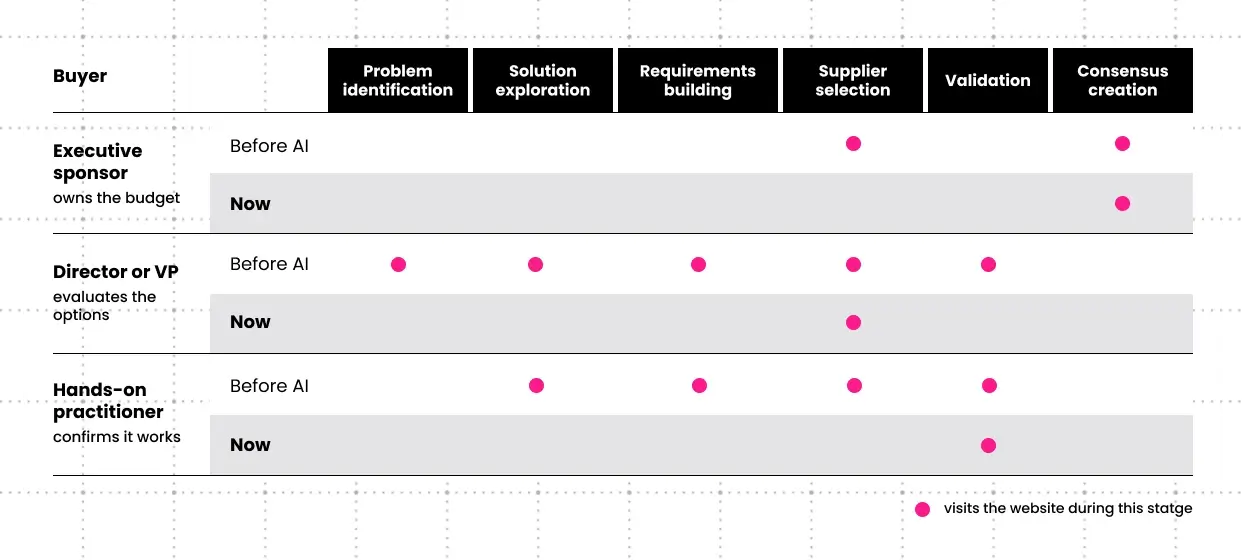
Our mapping of enterprise-scale B2B vendor website touchpoints across Gartner’s six B2B buying jobs, by buying committee role, built from Forrester’s 2026 Buyers’ Journey research, G2’s 2026 Answer Economy report, and 6sense’s Buyer Experience Report.
The grid also shows something the raw numbers hide: the three remaining visits don’t land on the same stage. The sponsor’s happens at consensus creation, the director’s at supplier selection, and the practitioner’s at validation. Each role makes one visit, and each visit has a different job to do, which is why a homepage built as a general tour now serves nobody in the room.
What each role checks now
The executive sponsor always had the shortest relationship with your website, and AI shortened it further. Instead of asking a team to pull together options, today’s sponsor opens an AI conversation directly, forms a view of the category, and arrives carrying a draft of the board narrative they’ll need to defend. Their one visit is a credibility check. They’re looking for evidence you’ll still exist in three years and for named peers who already trust you, and the whole story has to survive a CFO’s questions.
The director or VP absorbed the deepest compression. This role used to live on vendor sites, comparing feature pages and reviews, filling out gated forms just to get past the marketing. That comparison work now happens in the LLM first: G2 found that comparing vendor strengths and weaknesses is the number one AI use case in software research, and that chatbots influence 54% of shortlists. By the time this buyer reaches your site, they’re pressure-testing two or three finalists against real constraints like budget, stack, security, and timeline. A thoughtful framework for evaluating an agency partner still matters here. It just gets applied earlier and faster than it used to.
The hands-on practitioner is the one role AI can’t finish the job for, because AI can front-load the learning but it can’t run a proof of concept. This buyer still needs to touch something real, whether that’s a sandbox, a working demo, or a case study specific enough to check against their own stack. Forrester’s 2026 research shows reliance on trials growing for exactly this reason. AI compressed this role’s research more than anyone’s and left the verification step carrying more weight than ever, because it’s the last place the AI’s shortlist gets confirmed or thrown out.
Your site’s new main job: AI verification
None of the three shows up to learn what you do; an AI conversation already covered that. They’re on your site to find out whether what they heard was true.
Forrester found the same pattern from the other direction: buyers distrust unverified AI output and compensate by seeking validation from trusted sources before they commit, including peers, industry experts, and the vendors themselves. This is how the whole market is resolving the gap between fast AI answers and high-stakes decisions, and it’s well past the early adopters.
Most B2B websites were built for the opposite buyer, someone who arrives early, knows little, and wants a tour. Serving the buyer who actually shows up means two things. You have to be citable enough that AI includes you in the shortlist at all. Then you have to be transparent enough that a skeptic can confirm what they already believe and leave with something they can defend internally.
AI and human content layers
The obvious objection: the content still has to exist somewhere, so does the work really change? It does, because every important fact now has two readers, and they verify it differently.
Take a SOC 2 verification. Written as a structured claim, with what you hold, who audited it, and what period it covers marked up so a model can extract it, it’s the version an AI cites when a buyer asks which vendors meet their security bar. Written as a page a human can use, with the report available on request, the audit history, and a plain-language summary the director can forward to their own security lead, it’s the version that gets verified in ninety seconds and carried into an internal meeting.
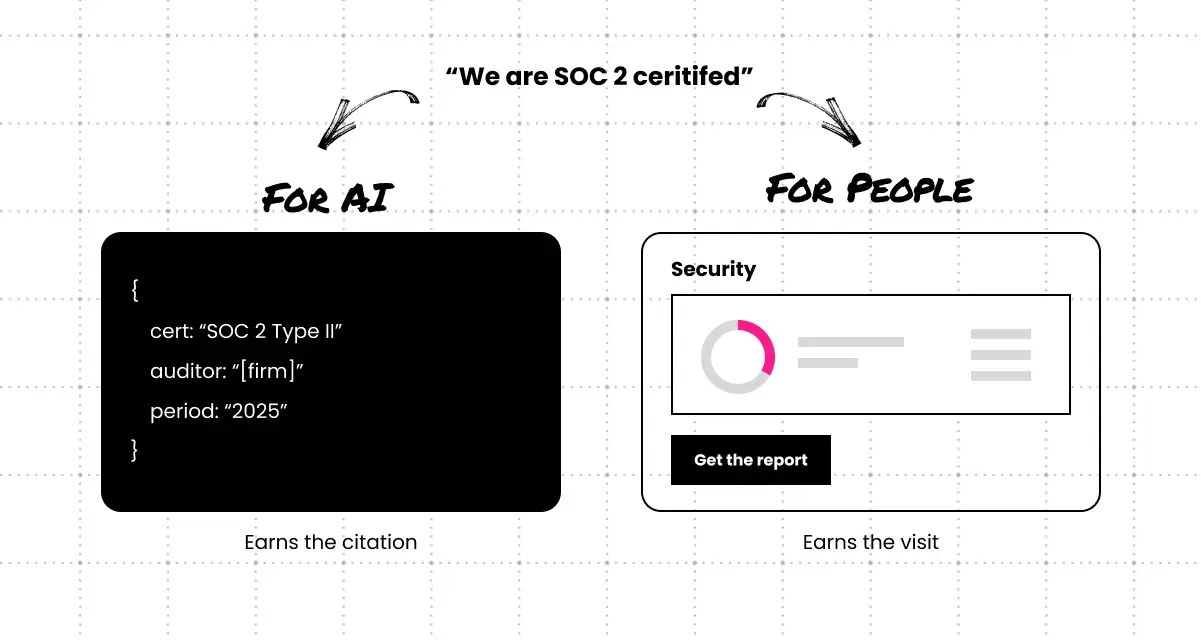
The same split applies to outcomes. A conversion lift earns the AI citation when it’s published as a structured, sourced data point, and it earns the visit when it’s published as a full case study a skeptical buyer can sanity-check. It’s one set of facts, maintained in one place and expressed two ways. Skip the structured layer and AI never surfaces you. The human layer matters just as much, because a buyer who lands on a page shaped for machines has nothing to carry into their next internal meeting.
What to change first
Three things you can act on this quarter.
- Turn your security posture into a page. Most B2B sites make you request a PDF. Put the certification, the auditor, the coverage period, and a plain summary on a URL, then mark it up so a model can extract it.
- Rewrite one case study to be checkable. Named client, real numbers, the timeline, the stack, what went wrong. A skeptic reading a case study is looking for the detail that proves you were actually there.
- Give your ten most important claims a structured layer. Every number you want cited needs a version a model can lift cleanly: the claim, the source, the date, the scope.
What has to hold up on sight
The old playbook assumed you had the buyer’s whole research journey to work with. Gate the PDF to capture the lead, keep pricing vague to force a call, tune the homepage to rank. That runway is gone. Pricing, security posture, and real outcomes now need to hold up the moment a skeptical visitor lands, because that moment is the whole engagement.
We hold ourselves to the same standard. Our website budget calculator publishes real project ranges in public, sourced and ungated, because a buyer who has to fill out a form to learn what things cost has already been handed a reason to distrust the rest. It’s the same shift behind the broader rethink of what a B2B website actually needs to accomplish once AI sits in front of it rather than beside it.
If your site was built four years ago for a buyer who no longer exists, the honest question is whether you’re looking at a redesign or something lighter.
And if you’re not sure whether your own site is built for a checking visit or a touring one, that’s worth a conversation before the next redesign gets scoped. Let’s talk.
Get our latest insights in your inbox

8 Criteria for Choosing a B2B Web Redesign Agency
By Clear Digital on September 15, 2026
Read more
What a B2B Website Redesign Requires From Your Team
By Clear Digital on September 11, 2026
Read more
How to Justify a Website Redesign to Your CEO, CFO, or Board
By Clear Digital on September 11, 2026
Read more