
The digital landscape has evolved dramatically since the early days of the basic content management system (CMS). Driven by demand for omnichannel content delivery, rapid deployment cycles, and a seamless customer experience across web, mobile apps, and other digital touchpoints, CMS tools have matured into robust, modular digital experience platforms (DXPs) powered by headless architecture.
Marketing teams, CMOs, and CTOs today require more than a traditional CMS platform can offer. They need flexible solutions that decouple the frontend from the backend, empowering both developers and content creators. As experts in helping companies choose and implement the right headless CMS or DXP solution, we’ve put together this guide to help you understand what a headless DXP is, why you should consider one over a traditional system, and most importantly, how to evaluate and choose the right one for your unique needs. Let’s dive in.
What is a headless digital experience platform?
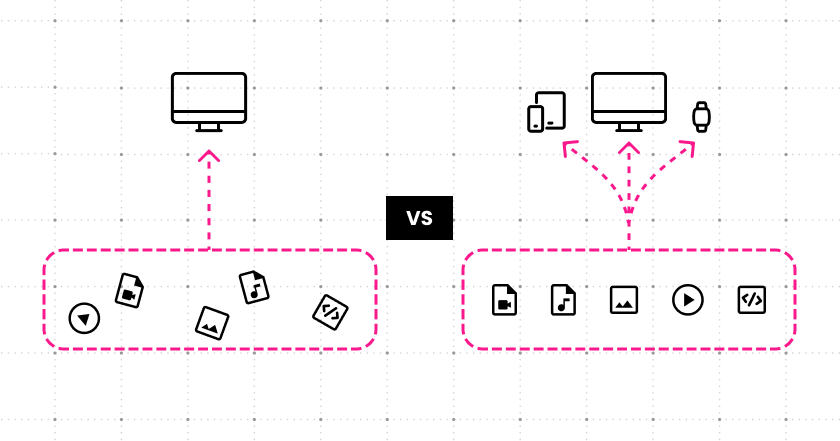
A headless DXP is a modern content management system that separates the content and presentation layers. Unlike traditional CMS platforms, where the backend and frontend are tightly coupled, a headless CMS delivers content via APIs (typically REST or GraphQL), allowing you to push digital content to multiple platforms from a single source.
In addition, headless DXPs integrate personalization, analytics, digital asset management, and commerce capabilities — essentially combining content delivery with marketing. Composable DXPs align well with MACH principles (microservices, API-first, cloud-native, headless), supporting a future-proof stack. Increasingly, companies are embracing a decoupled or headless CMS approach to improve control over content creation and delivery.
Why selecting the right DXP is so critical
Choosing the right headless CMS platform isn’t just about features, it’s about enabling your team and aligning with your long-term strategy. If you choose the wrong platform, you could end up limiting agility, straining development resources, and getting locked into costly upgrades.
Key considerations include:
- Long-term platform scalability
- How it fits with your existing martech stack
- Agility for marketing teams to launch and manage content
- Developer flexibility through APIs
- Licensing and support models that match your operational model
- Complex content management capabilities and workflows
At Clear Digital, we’ve seen firsthand how a well-matched platform can elevate digital marketing and CX — and how the wrong choice can slow everything down.
Key criteria for choosing a headless DXP
Here’s what to look for when evaluating headless CMS options:
- Scalability + performance
- Can the platform handle your current and future traffic?
- Is performance consistent across global delivery regions?
- Ease of use for marketers + content creators
- Intuitive content modeling and editing?
- WYSIWYG and live preview support?
- Support for flexible content types?
- Developer experience + API flexibility
- REST API or GraphQL support
- SDKs, CLI tools, and flexible architecture
- Friendly for teams building decoupled frontends
- Security + compliance
- SOC 2, GDPR, HIPAA compliance support
- Role-based access control for managing content
- Integration capabilities
- Native integrations with Salesforce, HubSpot, Marketo
- Extensible APIs for custom workflows
- Community + partner ecosystem
- Access to experienced partners
- Active developer and content editor communities
- Total cost of ownership (TCO)
- Transparent licensing
- Predictable pricing as your needs scale
- Speed to market
- How quickly can you launch a new product or campaign?
- Ability to iterate and manage content independently
Comparing top platforms: Contentstack vs Contentful vs Sanity vs Prismic
Now, let’s look at how the top headless CMS solutions stack up.
| Platform | Ideal Use Case | Marketer Usability | Dev Flexibility | Integrations | Pricing Tier | Partner |
|---|---|---|---|---|---|---|
 |
Enterprise-grade composable DXP | Moderate | High | Extensive (Salesforce, SAP) | $$$ | Strong global partner network |
 |
Mid- to enterprise-level CMS | High | High | HubSpot, Marketo, Commerce tools | $$$ | Mature support model |
 |
Custom digital experience projects | Moderate | Very high | Developer-friendly, composable dxp tools | $$ | Smaller partner base |
 |
Fast deployment, SMBs | High | Moderate | Limited native options | $ | Basic support structure |
All four platforms support headless CMS architecture and omnichannel content delivery. However, which solution is best for your business depends on your unique content management needs, team composition, and digital experience priorities.
Why traditional CMS platforms are falling short
Traditional CMS platforms like WordPress or Joomla bundle the frontend and backend into a single stack, limiting flexibility for developers and marketers. In contrast, headless CMS platforms enable composable architectures and empower teams to build future-proof digital experiences.
A traditional CMS often makes it harder to scale across channels, introduce a mobile app, or integrate with a headless ecommerce platform. As marketing complexity increases, so does the need for a headless CMS solution that separates concerns and accelerates content delivery.
How we approach headless platform selection
At Clear Digital, we’ve helped many clients evaluate, implement, and grow their content infrastructure using platforms like Contentstack, Contentful, Sanity, and Prismic — as well as traditional CMS platforms like Drupal and AEM.
Our consultative process ensures:
- Alignment with internal developer and content creator workflows
- Smooth integration into your digital marketing stack
- Scalability across multiple platforms and touchpoints
We can help you figure out how to choose the right headless CMS, compare platform and options, and optimize content modeling for content creation workflows. Our approach emphasizes headless CMS best practices and digital marketing strategy to deliver outstanding customer experiences.
How to choose the right headless CMS for your organization
When evaluating headless CMS platforms, it’s essential to:
- Clarify your goals for content creation and delivery
- Understand your team’s technical expertise
- Identify your need for omnichannel content delivery
- Assess your need for a composable DXP vs standalone CMS
- Match features to your business use cases (e.g., headless commerce, mobile app, blog, product catalogs)
Whether you’re looking for the best headless CMS for your website or exploring a decoupled CMS to modernize your digital experience, selecting the right platform is critical to your success.
Next steps for decision makers
When it comes to choosing the best headless CMS, there’s no one-size-fits-all solution. The right platform depends on your business needs, team skills, and digital content strategy.
If you’re comparing headless CMS options or considering a move from a traditional CMS platform, take time to think about your headless CMS architecture needs, try out different tools, and talk to experts.
Our Clear Digital team is here to help you build the frontend for headless CMS projects, guide your digital transformation, and deliver the best possible user experience. Let’s talk about how to choose the right headless digital experience solution for your team.
Get our latest insights in your inbox
8 Criteria for Choosing a B2B Web Redesign Agency
By Clear Digital on September 15, 2026
Read more
What a B2B Website Redesign Requires From Your Team
By Clear Digital on September 11, 2026
Read more
How to Justify a Website Redesign to Your CEO, CFO, or Board
By Clear Digital on September 11, 2026
Read more