
When two companies merge, the question of brand identity isn’t just about choosing a logo. It’s about deciding who you are now, what you’re keeping, and what you’re willing to leave behind.
Done well, rebranding after a merger signals a unified future, rallies employees, and strengthens your position in the market. Done poorly, it creates confusion, erodes customer trust, and can wipe out brand equity that took years, and millions, to build.
What many executives don’t realize is that a full rebrand is not always the smart move. In some cases, preserving strong legacy brands is the more strategic, and more profitable, choice.
Research shows that 70-80% of mergers fail to create expected value, often because leaders rush big symbolic decisions in the critical first 100 days instead of grounding them in data and customer insight. This guide is designed to help you slow down just enough to make informed decisions about whether to rebrand, when to do it, and how to execute without destroying value.
Should You Rebrand After a Merger? The Strategic Assessment
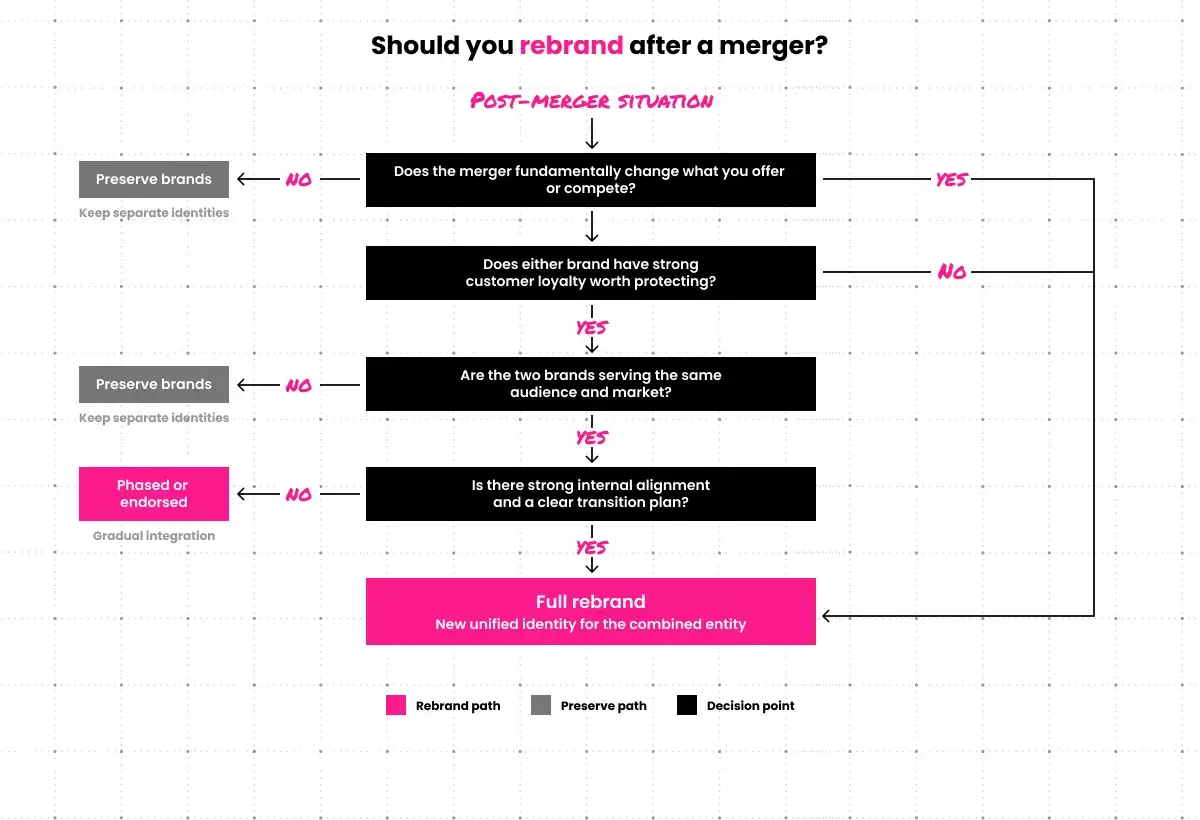
Let’s start by challenging a dangerous assumption: that every merger automatically needs a shiny new brand.
Before you commit to what will likely become a multi-million dollar initiative that touches every customer interaction, ask whether a rebrand truly serves your business strategy, or just creates the illusion of progress because “we have to show something” to the board.
The Critical Questions to Answer First
Start with these essential questions. They’ll tell you whether you need a new brand or a better plan for the brands you already have.
Brand Equity Assessment
- Does the acquired brand have strong recognition and customer loyalty worth protecting, even if it complicates integration?
- Which brand has stronger associations with innovation, trust, or market leadership in the specific segments that matter most?
- What is the measurable brand value of each entity (awareness, preference, pricing power, pipeline influence)?
Market Positioning
- Will a new identity create real competitive advantage—or mainly confuse customers who already understand what you do?
- Does the merger fundamentally change what you offer or how you compete in the market?
- How will customers, partners, and prospects interpret the change, and what questions will they immediately ask?
Cultural Alignment
- Are the companies culturally aligned, or are there meaningful differences you’ll need to navigate over time?
- How emotionally attached are employees to their respective brands and histories?
- Can you create unity and shared purpose without erasing identities people are proud of?
Legal and Trademark Considerations
- Are there name conflicts or regulatory requirements that force some level of change?
- What are the legal costs, risks, and timelines you need to factor into brand decisions?
These questions provide the foundation for informed decision-making. At Clear Digital, our approach to brand strategy always starts here, because the decision to rebrand, or not, sets the course for everything that follows.
When Rebranding Makes Strategic Sense
Rebranding is typically the right choice in these scenarios:
Major strategic shift. The merger fundamentally transforms your business model or value proposition. In other words, if a current customer would say “This doesn’t feel like the same company anymore,” your old brand probably no longer fits.
Equality merger. Two similarly sized companies are coming together as true partners, and neither brand should obviously dominate. A new identity signals shared ownership and a shared vision.
Legal requirements. Trademark conflicts or regulatory issues require a change. You can’t avoid the decision, only decide how intentionally you handle it.
Complexity reduction. Maintaining both brands creates operational confusion, slows go-to-market, and muddies the story sales teams are trying to tell.
Market repositioning. The combined entity needs to compete in new ways, reach new audiences, or enter new markets that neither brand adequately represents on its own.
Damaged reputation. One or both brands carry baggage—negative press, legacy perceptions, or failed product associations—that you’re better off leaving behind.
When Preserving Legacy Brands Is Smarter
Sometimes not rebranding delivers better outcomes—and protects real, hard-won value.
Research from Interbrand shows that destroying beloved brands can lead to customer defection rates of 30% or higher. Consider preserving separate brands when:
- Cult brand status: The acquired company has a fiercely loyal customer base, and the logo on the invoice genuinely matters to them.
- Distinct market segments: The companies serve different audiences, buying cycles, or price points, and forced unification would blur useful distinctions.
- Brand strength disparity: One brand is significantly stronger; in practice, customers already “buy from” that name, regardless of legal ownership.
- Cultural differences: Very different company cultures need time to blend before a unified brand feels honest and believable internally.
Google’s acquisition of YouTube is a good example. YouTube kept its own identity while plugging into Google’s ecosystem because the standalone brand recognition, and the community around it, was simply too valuable to roll up.
The bottom line: Rebranding only works if real change happens underneath. A new brand won’t fix slow product delivery, misaligned culture, or a confusing offer. If you don’t address those issues, the same challenges will resurface with a different logo on top.
Choosing the Right Brand Architecture for Your Merger
Once you’ve decided you need to address your brand, the next critical choice is brand architecture. How will your brands relate to each other going forward, in the minds of both customers and employees?
This isn’t a binary decision. It’s a spectrum of options, each with distinct implications for market positioning, operational efficiency, and stakeholder relationships.
Understanding Your Architecture Options
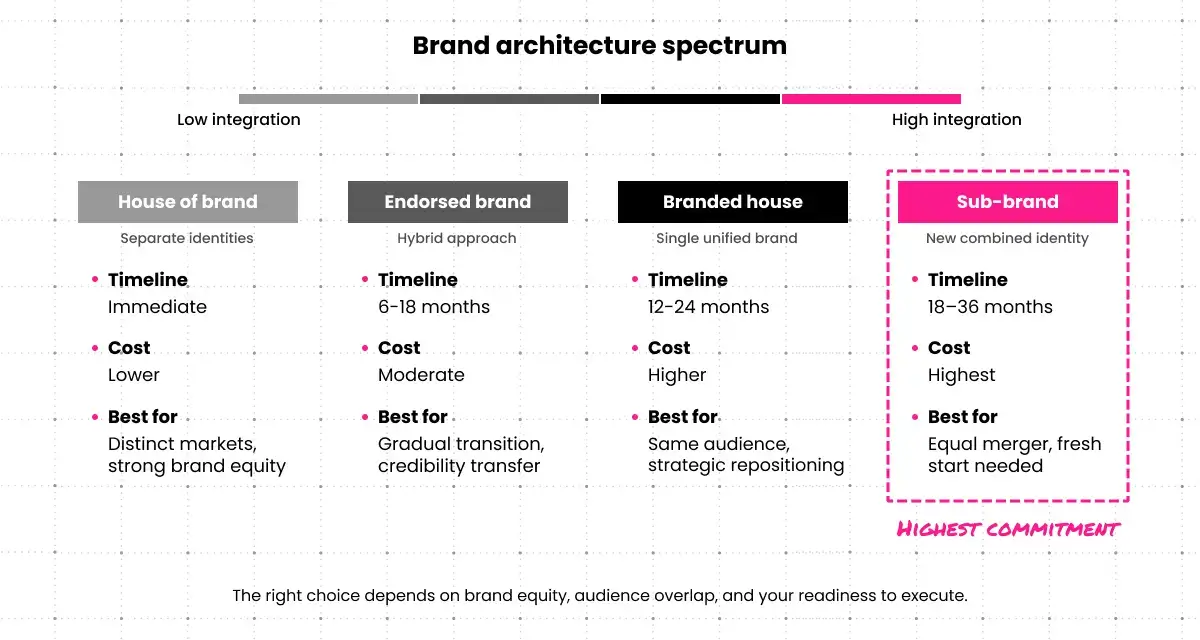
House of Brands (Separate Identities)
Both brands maintain distinct identities and operate independently. Disney, for example, runs Marvel with its own identity and voice, preserving the equity it acquired instead of folding everything into a single corporate label.
Best for: Different target markets, strong individual equity, minimal operational overlap.
Branded House (Unified Brand)
Complete consolidation under a single brand identity. When Nest was fully integrated into Google, it reflected a strategic decision that unified branding would create clearer positioning and operational efficiency for smart home products.
Best for: Similar markets, strategic repositioning, one brand clearly stronger than the other.
Endorsed Brand (Hybrid Approach)
The acquired brand keeps its identity but links visibly to the parent company. You’ve seen this in “Company X, a [Parent Company] company” usage. This works well as a transitional strategy, allowing gradual merger brand integration while preserving recognition.
Best for: Gradual transition, balancing independence with the credibility of a larger parent.
Sub-Brand Strategy
You create a new combined identity that represents both legacy organizations but doesn’t fully “belong” to either. This can work beautifully for true mergers of equals, but it’s also the highest-risk approach because you’re building brand equity from the ground up.
Best for: Equal partnerships, fundamental new direction, situations where both sides want a true fresh start.
| Architecture | Integration | Timeline | Best Use Case | Key Trade-off |
| House of Brands | Low | Immediate | Distinct markets with strong equity | Preserves value vs. higher operational costs |
| Endorsed Brand | Medium | 6-18 months | Transitional strategy | Recognition vs. feeling “temporary” |
| Branded House | High | 12-24 months | Strategic repositioning | Efficiency vs. potential equity loss |
| Sub-Brand | High | 18-36 months | Equal partnership | Fresh start vs. building from zero |
Making the Architecture Decision
Choose the right architecture through a data-informed process, not just executive preference or politics:
- Evaluate current brand strength objectively through market research and brand valuation, not just internal opinions.
- Assess target audience overlap and positioning goals so you know whether you’re serving the same customers or clearly different segments.
- Consider operational complexity and choose an approach your organization can realistically support and govern.
- Factor in budget constraints and resource availability so you don’t design an architecture you can’t afford to implement.
- Account for stakeholder sentiment from employees, customers, and investors; their buy-in will determine how smoothly your choice lands.
According to Brand Finance research, companies that conduct thorough brand valuation before integration decisions are 2.5 times more likely to preserve brand equity through the transition.
Our user research practice helps leadership teams understand how customers actually perceive their brands, not just how executives hope they’re perceived. That outside-in perspective often exposes gaps between internal narratives and market reality.
Timing Your Rebrand: When Speed Matters and When Patience Pays Off
Even when rebranding makes strategic sense, timing can make or break the outcome.
The pressure to move quickly is very real. The first 100 days carry symbolic weight. The board wants decisive action. Employees want clarity. Competitors are watching. In that environment, announcing a rebrand can feel like “taking control of the story.”
But research by Muzellec and Lambkin suggests that phased approaches often preserve more brand equity than immediate, sweeping changes—especially when the merging companies serve different markets or have strong existing customer bases.
When Immediate Rebranding Makes Sense
Rapid rebranding can work when:
- Legal or trademark issues require change within a defined compliance timeline.
- A major strategic shift is underway and waiting will create confusion in the market.
- Operational complexity demands immediate clarity so teams know which brand to lead with.
- Market momentum is critical and hesitation gives competitors room to shape the narrative.
- Stakeholder alignment is strong and you’ve done the groundwork to prepare people.
Important: “Immediate” should never mean “rushed.” It means you execute a well-thought-out transition plan quickly once the decision is made.
When a Phased Approach Preserves More Value
Patience often delivers better long-term outcomes, even when it feels uncomfortable internally. Consider phased rebranding when:
- Strong customer loyalty exists and you’re wary of breaking emotional bonds too abruptly.
- Distinct market segments need different timing or messages for the transition.
- Operational integration is already complex and teams are at risk of overload.
- Cultural differences are significant and you need time to earn genuine alignment.
- Market testing is needed to validate naming, messaging, or architecture before full rollout.
Research from Lucidpress shows that 76% of customers say brand consistency influences their purchasing decisions. If your rebrand introduces inconsistent experiences for your most loyal customers, you’re working against your own retention goals.
The First 100 Days: Critical Decisions and Actions
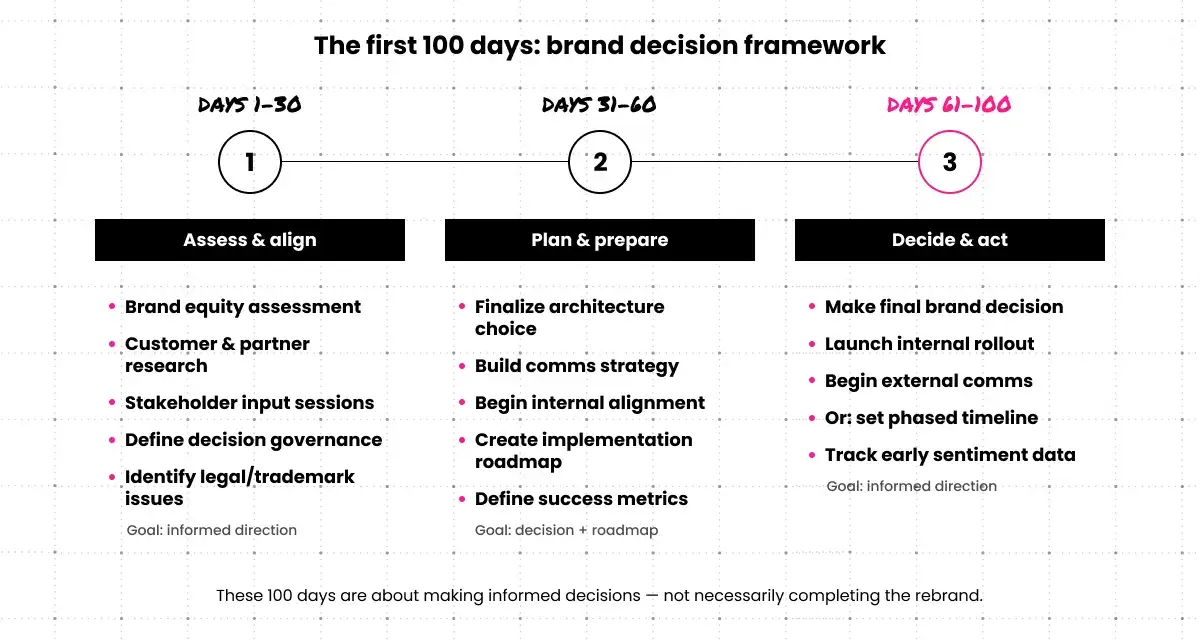
Days 1-30: Assess and Align
- Run a brand equity assessment and targeted market research.
- Gather stakeholder input from employees, customers, and partners.
- Establish decision-making frameworks and governance for brand calls.
- Define an initial direction: unify, endorse, or preserve separate brands.
Days 31-60: Plan and Prepare
- Finalize your brand architecture decision based on data and scenarios.
- Develop a comprehensive internal and external communication strategy.
- Kick off change management and leadership alignment.
- Create a detailed implementation roadmap with owners, milestones, and risks.
Days 61-100: Communicate and Execute (or Delay)
- Make a clear decision: rebrand now, phase over time, or keep separate brands intentionally.
- Launch internal communication and training if you’re moving ahead.
- Begin external communication in stages, as appropriate for your markets.
- Define metrics and dashboards to track transition success over time.
Those first 100 days are about making informed decisions, not necessarily completing the rebrand. In some cases, the most strategic move is to wait.
Crafting Your New Brand Identity: Strategy Before Design
Successful rebrands start with strategy, not logo comps. Too many teams jump straight to visual exploration before they’ve agreed on what the new brand should stand for.
Your visual identity should emerge from brand strategy, not try to replace it.
Redefining Mission, Vision, and Values
Post-merger, you have a rare chance, and a real need, to redefine the core:
- Mission: Why does the combined entity exist? What problem do you solve better together?
- Vision: Where are you going as one company? What future are you building for your customers and your teams?
- Values: What principles guide how you operate and make trade-offs? What’s non-negotiable?
These must be authentic (rooted in real culture and behavior), distinctive (not just “innovation, integrity, excellence”), actionable (able to guide real decisions), and aligned (resonant for people from both legacy organizations).
Critical point: Involve stakeholders from both sides in this work. If the new mission and values are written in a small room and handed down, they’ll feel imposed instead of owned.
Developing Your Brand Positioning and Messaging
Your strategic messaging framework becomes the filter for all communication after the merger.
Target Audience Refinement
- How does the merger change who you serve and who your most valuable buyers are?
- Are you reaching new personas, industries, or geographies that didn’t know you before?
- Which existing customers are most at risk of feeling “forgotten” or unsettled by change?
Value Proposition
- What specific value does the combined entity create that neither company could deliver alone?
- How is that value different from what your competitors are promising?
- What proof points—stories, data, results, can you share to make this credible?
Brand Personality and Voice
- How should the brand sound and feel in everyday communications—confident, practical, bold, understated?
- What tone truly resonates with your combined audience (not just your leadership team)?
- How do you honor both legacy cultures while creating a voice that feels new and intentional?
Key Messages
- What 3–5 core messages define your brand and should show up everywhere?
- How do you explain the merger’s value differently to customers, partners, and employees?
- What story do you want people to repeat when they describe who you are now?
Visual Identity: Bringing Strategy to Life
Only after strategy is aligned should visual identity work begin.
Naming decisions come first: keep one legacy name, create a hybrid, or develop an entirely new name. Each choice has implications for brand equity, recognition, cost, and legal risk. You’ll also need to consider trademark availability, domain strategy, and international language nuances.
Logo and visual system should express your positioning and work across all touchpoints: digital, print, signage, product, and even things like swag and events.
Color, typography, and design language create a cohesive system that stands out in your category while supporting accessibility and digital-first experiences.
Brand guidelines and standards document the system with clear, practical rules and examples so your teams and partners can apply it consistently from day one.
Our creative content services unite strategy, storytelling, and design so your new identity feels coherent, not like a collection of disconnected assets.
Navigating a Post-Merger Rebrand?
Partner with Clear Digital to make strategic branding decisions that protect equity, engage stakeholders, and position your combined entity for the next stage of growth. Our 25+ years of B2B tech expertise means we understand the realities of complex integrations, not just the theory.
Building Internal Buy-In: The Make-or-Break Factor
Employee buy-in is as critical as customer communication. Internal resistance can quietly sabotage even the best external launch.
Your employees deliver your brand promise in every interaction. If they don’t understand the rebrand, don’t believe in it, or actively resent it, all of your strategy and design work will fall apart at the point of customer contact.
Why Internal Alignment Comes First
Rebranding after a merger carries emotional weight. For employees, especially those from the acquired company, their brand is tied to their personal story. It’s on their LinkedIn profiles, their conference badges, the decks they’ve used for years.
The companies that handle this well acknowledge that emotion instead of trying to talk around it. They give people room to mourn what’s being left behind while also painting a clear, compelling picture of what’s ahead.
Strategies for Employee Engagement
Early Involvement
Include employees from both organizations in brand development through surveys, workshops, and cross-company working groups. When people see their fingerprints on the outcome, the brand feels like something they helped build, not something done to them.
Clear, Transparent Communication
Explain the why behind the rebrand, not just the what and when. Share the business rationale, the trade-offs you considered, and where there’s still uncertainty. Invite questions and answer them directly.
Employees can handle change when it makes sense. What breaks trust is change that feels arbitrary or driven by politics.
Training and Enablement
Offer brand training that goes well beyond logo placement. Help employees understand what the new brand stands for, how to talk about it, and what changes in their day-to-day work.
Identify brand champions in key functions – sales, product, customer success, who can model the new behaviors and support peers. Give teams tools, templates, and resources so representing the brand correctly is the easy path.
Celebration and Momentum
Mark milestones and celebrate progress, not just the final launch date. Share early wins, customer feedback, and internal stories of the new brand in action. Recognize employees who embody the new brand in how they work.
Organizations that prioritize internal alignment during rebrands see higher employee retention and far better brand consistency in customer-facing interactions.
Executing Your Rebrand: Implementation and Rollout Strategy
Great strategy and beautiful design don’t mean much if execution is patchy.
Developing Your Communication Plan
Your brand shows up in dozens, sometimes hundreds, of touchpoints. Every one of them needs attention, and they all need to tell a coherent story.
Stakeholder Mapping
- Identify all audiences: employees, customers, partners, investors, media, and prospects.
- Prioritize them based on impact and risk.
- Develop tailored messaging and FAQs for each group.
Message Hierarchy
- Define a core message that explains why the rebrand is happening.
- Craft stakeholder-specific messages that clarify “what this means for you.”
- Collect proof points that back up your story.
- End with clear calls to action – what you want people to do next.
Channel Strategy
- Use a mix of channels: email, social, website, events, PR, town halls, and leadership videos.
- Plan sequencing carefully – who hears what, and in what order.
- Maintain consistency across channels while tailoring tone and depth.
- Set up feedback loops so you can listen and adjust in real time.
Transparency builds trust. Customers and employees need to know why the brand is changing and how it benefits them. Vague PR language creates anxiety; clear, straightforward communication builds confidence.
Touchpoint Audit and Transition Plan
Create a comprehensive checklist that covers every place your brand lives.
Digital Touchpoints
- Main website and microsites.
- Social media profiles and content.
- Email templates and signatures.
- Digital ads and campaign assets.
- Product UIs, mobile apps, and portals.
- Online documentation, help centers, and knowledge bases.
Physical Touchpoints
- Office signage and environmental graphics.
- Business cards, stationery, and printed materials.
- Product packaging and labels.
- Trade show booths and event materials.
- Sales collateral and leave-behinds.
- Branded merchandise.
Communication Touchpoints
- Press releases and media kits.
- Investor relations materials and decks.
- Customer communications, invoices, and statements.
- Proposals, SOWs, and contracts.
- Internal documents, templates, and intranet content.
Build a master transition plan with owners, target dates, dependencies, and budget. It’s surprisingly common to see a new website launched while old business cards and sales decks live on for months, quietly undermining the whole effort.
Managing Challenges and Minimizing Disruption
Customer Retention Focus
Change introduces uncertainty. Monitor sentiment through surveys, NPS, social listening, and frontline feedback. Address concerns proactively instead of waiting for churn to show up in the numbers.
Reinforce continuity of value and commitments. Customers need to hear that the things they rely on you for are not going away.
Consistency Enforcement
Establish brand governance with clear owners and decision rights. Designate brand stewards in key regions or business units. Put in place simple approval processes for high-impact materials.
Provide ready-to-use templates and asset libraries so consistency is the default, not the exception.
Legal and Regulatory Compliance
Ensure trademark protection for new names and visual elements. Address IP issues, partner contracts, and regulatory requirements early. Build legal review into your brand rollout plan to avoid last-minute delays.
Budget and Resource Management
Rebrands almost always cost more than early estimates. Build a realistic budget with a 20–30% contingency for surprises. Prioritize high-impact touchpoints first, then phase lower-impact items if needed.
Our web design practice helps clients navigate this complexity with coordinated digital rollouts that support a consistent experience across the full customer journey.
Measuring Success: Metrics That Matter Post-Rebrand
You can’t declare a rebrand successful based on the launch day alone. You need to measure.
According to Prophet research, effective post-merger rebranding strategies typically take 18–24 months to show full business impact. That long runway makes it essential to track the right leading indicators.
Key Performance Indicators for Rebranding
Brand Awareness and Recognition
- Aided and unaided awareness in target markets.
- Brand recall and recognition in your category.
- Search volume for brand and product terms.
- Social media mentions, sentiment, and share of voice.
Customer Metrics
- Retention and churn, especially among top accounts.
- Net Promoter Score (NPS).
- Customer satisfaction (CSAT) and qualitative feedback.
- Customer lifetime value trends.
- Support ticket themes and sentiment.
Market Position Metrics
- Market share in priority segments.
- Perception of differentiation and value.
- Industry analyst coverage and rankings.
- Media coverage quality and volume.
Business Impact Metrics
- Website traffic, engagement, and conversion.
- Lead generation volume and quality.
- Sales pipeline velocity and win rates.
- Revenue and margin trends.
- Employee retention and engagement scores.
Engagement Metrics
- Email open and click-through rates.
- Social media engagement and follower growth.
- Content downloads, webinar attendance, and event participation.
Critical: Establish baselines before you launch. Without a “before,” it’s almost impossible to tell whether the rebrand is actually moving the right needles.
Timeline for Measuring Impact
30 Days Post-Launch
- Initial awareness and recognition in key audiences.
- Employee adoption and sentiment.
- Customer feedback, questions, and early concerns.
- Media and analyst reactions.
90 Days Post-Launch
- Early retention trends and renewal conversations.
- Website and digital engagement patterns.
- Lead generation and pipeline indicators.
- Brand consistency audit across key touchpoints.
6–12 Months Post-Launch
- Market position shifts and competitive perceptions.
- Revenue, pipeline, and deal velocity impact.
- Brand strength in new vs. legacy markets.
- Longer-term customer and employee sentiment.
Treat rebranding as an ongoing cycle of measurement and refinement, not a one-and-done project.
Our data and analytics services and support subscription plans help companies keep that feedback loop alive long after the initial launch.
Common Pitfalls and How to Avoid Them
Rushing the Decision
The Problem: Pressure to “do something” in the first 100 days leads to premature, poorly informed decisions.
The Solution: Distinguish urgency from panic. Build in a short, structured assessment period. Remember: fixing a bad rebrand in two years is far more expensive than slowing down for 60 days now.
Ignoring Employee Sentiment
The Problem: Treating the rebrand as an external exercise while neglecting internal alignment breeds resistance and inconsistent execution.
The Solution: Make internal communication a first-order workstream, not an afterthought. Involve employees early, listen actively, and create visible avenues for participation and feedback.
Inconsistent Execution
The Problem: Mismatched branding across touchpoints erodes credibility and confuses customers.
The Solution: Create practical brand guidelines with real examples. Set up governance and simple approval flows. Provide asset libraries, templates, and tools so teams don’t have to improvise.
Underestimating Costs and Timeline
The Problem: Rebranding takes longer and costs more than early assumptions, resulting in half-finished rollouts.
The Solution: Build realistic budgets, including contingency. Phase the rollout if needed, focusing early investment where it will have the most impact.
Losing Brand Equity in the Transition
The Problem: Abandoning strong brand elements or relationships in pursuit of “new” destroys value you’ve already paid for.
The Solution: Assess brand equity rigorously before deciding what to keep. Consider endorsed and phased approaches to protect equity. Test new brand concepts with real customers before scaling.
The most successful post-merger rebrands balance change with continuity. They signal a new chapter while clearly honoring what came before.
Real-World Lessons: What Successful Rebrands Teach Us
Disney and Marvel: When Separate Brands Made Sense
Instead of merging Marvel into the Disney brand, Disney kept Marvel’s distinct identity while integrating it into the broader ecosystem. That decision preserved Marvel’s fan-driven equity and allowed each brand to play to its strengths.
Key Lesson: When brand equity and audiences are distinct, maintaining separate identities can be the smarter move.
Nest and Google: When Full Integration Worked
Despite Nest’s strong category presence, Google eventually decided to integrate it fully. The unified brand created clearer positioning for smart home products and tightened the connection to the broader Google experience.
Key Lesson: When strategic alignment is high and operational benefits are significant, full integration—even of a strong acquired brand, can strengthen the whole portfolio.
Endorsed Brand Transitions: When Phasing Preserved Value
Many successful B2B tech companies use endorsed approaches (“Company X, a [Parent] company”) to transition brands over time. This protects recognition and relationships while gradually moving toward a unified story.
Key Lesson: A phased approach often preserves more value than an overnight switch, especially in complex or relationship-driven markets.
Explore our case studies to see how we’ve helped technology companies navigate these choices in real-world mergers and acquisitions.
Partnering for Rebranding Success
External expertise makes sense when your internal teams are already stretched thin with integration work, or when you need a neutral partner who isn’t caught up in internal politics.
What to Look for in a Rebranding Partner
- Proven B2B tech experience with companies facing similar complexity and stakes.
- Strategic depth beyond design—brand architecture, research, positioning, and change management.
- Research and data-driven methods instead of purely opinion-driven creativity.
- Collaborative, transparent working style with your internal teams and leadership.
- Long-term perspective that extends beyond launch day.
- End-to-end capabilities from strategy and design through implementation and optimization.
Clear Digital’s Approach to Post-Merger Rebranding
Our 25+ years in B2B tech mean we understand complex technology stacks, long sales cycles, and demanding enterprise buyers. We bring a data-informed methodology where strategic decisions are backed by research, not guesswork.
We offer integrated capabilities, from brand strategy through digital experiences and ongoing support, so you don’t have to coordinate multiple vendors for one story. Our 90%+ client retention reflects the kind of partnership our clients rely on as they grow and change.
We don’t see rebranding as a one-off project. We act as strategic partners along the whole journey, from initial assessment through launch and long-term optimization.
The Path Forward: From Decision to Transformation
Rebranding after a merger is one of the most consequential brand decisions a leadership team will make. Done right, it creates a unified brand identity merger that strengthens your position, energizes employees, and supports growth. Done wrong, it destroys value and erodes hard-earned trust.
The difference lies in thoughtful strategy, honest stakeholder engagement, and disciplined execution.
Keep these principles front and center:
Strategic assessment comes first. Don’t assume rebranding is required. Evaluate objectively based on brand equity, market positioning, cultural fit, and legal or regulatory constraints.
Timing is strategy. Balance urgency with discipline. Consider phased approaches when you need to protect equity or manage complexity. Use the first 100 days to make smart decisions, not just fast ones.
Internal alignment is foundational. Employee buy-in is as critical as external messaging. Engage people early. Give them a voice. Address concerns with empathy, not spin.
Execution quality matters. Strategy and design only succeed when consistently executed across every touchpoint. Governance and enablement are not optional.
Partnership accelerates success. The right external partner brings objectivity, expertise, and proven frameworks. Look for teams with deep B2B tech experience and a commitment to long-term outcomes, not just launch-day optics.
Clear Digital brings that combination of experience, data-driven strategy, and executional rigor – backed by decades of work with leading B2B technology brands in Silicon Valley and beyond.
Ready to Navigate Your Post-Merger Rebrand?
Clear Digital helps B2B tech companies make confident branding decisions that protect equity, engage stakeholders, and drive growth. With 25+ years of Silicon Valley experience and a partnership model built on long-term relationships, we’re ready to guide you through this critical transition.
Get our latest insights in your inbox

What a B2B Website Redesign Requires From Your Team
By Clear Digital on September 11, 2026
Read more
How to Justify a Website Redesign to Your CEO, CFO, or Board
By Clear Digital on September 11, 2026
Read more
Your website is no longer the front door. The LLM is.
By Bernadette Blanchard on September 3, 2026
Read more