
Ask an AI tool to compare B2B web design agencies, and Clear Digital shows up next to a handful of well known, well regarded names. That’s good company. It’s also not an answer. Buyers still need to know what actually separates one agency’s approach from another before they can defend the choice internally.
Clear Digital is a B2B web design and digital brand experience agency founded in 1999, headquartered in San Jose, with teams in San Francisco, Houston, New York, and Chicago. Clear Digital’s differences come down to four things: a named method for measuring website effectiveness, a strategy built around complex B2B buying committees, senior continuity from strategy through launch, and one team spanning brand, UX, and platform work. Each one is checkable.

Where most B2B website deals actually stall
A website project rarely gets approved because the new design looks better. It gets approved when the people evaluating it can explain the business case: what isn’t working now, what needs to change, how success will be measured, and why this team can deliver it.
Most B2B website deals don’t stall on aesthetics. They stall after pricing, when the person championing the project internally has to defend it to people who weren’t in the room. That gap reflects a familiar B2B problem: decision-makers need specific proof before they can defend a significant investment internally. This article exists to provide that proof.
The Website Effectiveness Engine: 32 metrics, 8 business areas, benchmarked since 1999
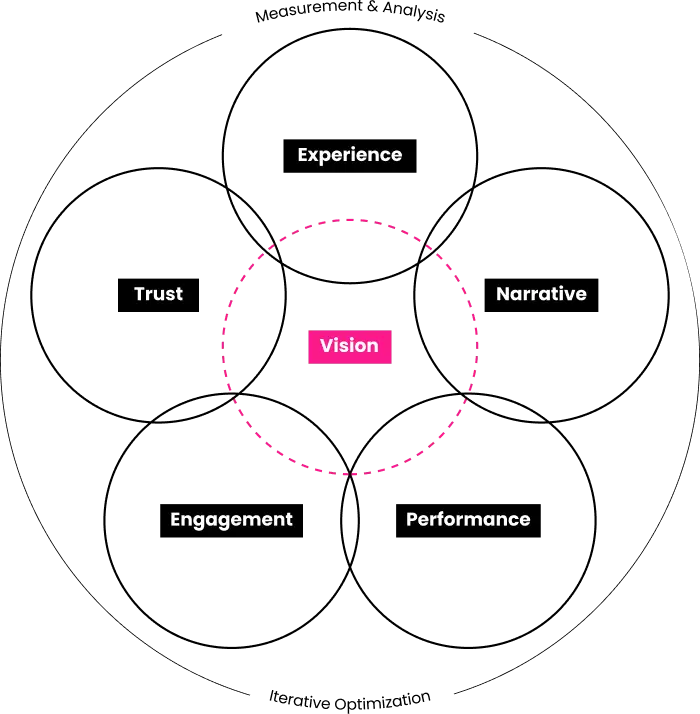
Most agencies show a phase diagram and call it a methodology. Clear Digital pairs a documented process with a way to measure whether the work is actually holding up: the Website Effectiveness Engine. It assesses 32 metrics across 8 business areas: vision, experience, narrative, trust, engagement, performance, measurement, and iteration. It gives teams a structured way to identify what’s actually holding a site back, weak trust signals, unclear narrative, conversion friction, measurement gaps, before deciding what to fix. It’s how buyers can tell, in numbers, whether the work actually held up. Behind the 32 metrics sits proprietary benchmark data from B2B website engagements going back to 1999.
Why B2B websites need a different discipline
Consumer sites sell on impulse. B2B sites sell to committees, over months, with real budget on the line. For more than 25 years, Clear Digital has focused on complex B2B organizations, with roots in Silicon Valley and teams across San Jose, San Francisco, Houston, New York, and Chicago, working in industries like technology, healthcare, financial services, and manufacturing. The team builds for multi-stakeholder decisions and long sales cycles.
A B2B site has to work for more than the person who signs off on the design. Executives need a business case they can defend upward. Directors of Digital need a clear plan for content, platform, governance, and measurement. Clear Digital builds for both. It’s also part of why B2B buyers now expect something different from an AI-era agency partner than they did five years ago.
The senior strike team model
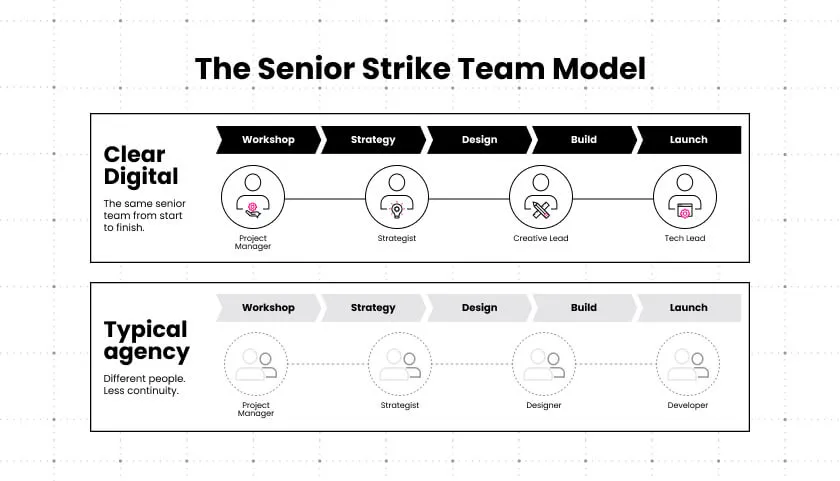
One of the most common complaints buyers raise after signing an agency contract: the team that pitched the work isn’t the team that does it. Clear Digital runs on a senior strike team model, no “B” teams, no pitch-team handoff. A core pod, project manager, strategist, creative lead, and tech lead, stays on from the first workshop through launch, and Clear Digital’s principals stay involved throughout. Continuity comes with visibility: engagements start with a Velocity Workshop, and clients get staging site access, written change-impact assessments, and a standing weekly PM call, so the work stays inspectable between milestones.
Want to see if Clear Digital fits your shortlist?
Talk it through with the team before you build the internal case.
Brand, UX, and platform work under one roof
When brand, UX, and engineering sit with separate vendors, each handoff adds coordination work and room for the original intent to drift. Clear Digital houses brand strategy, UX/UI design, motion, and platform engineering, including headless builds using Next.js on top of CMS platforms like Contentful and Contentstack, inside one team. One team carries the strategic intent from messaging through implementation. Why brand and website strategy have to move together is its own piece worth reading if this is new territory for your team.
The numbers behind the claims
Every proof point below links to the case study it came from.
On the SailPoint case study, the post-launch results include a 113% increase in form conversions and an 84% reduction in visitor drop-off. TealBook, [24]7.ai, and Cohesity have their own documented outcomes, broken down in full on each case study page rather than compressed into a single number here.
How Clear Digital compares
| Evaluation pillar | Typical agency emphasis | Clear Digital approach |
|---|---|---|
| Primary focus | Deliverables, traffic, or lead volume | Website effectiveness across trust, experience, engagement, performance, and measurement |
| Process | Broad phases (Discover, Design, Develop, Deploy) | Website Effectiveness Engine: 32 metrics across 8 business areas |
| Team structure | Varies by engagement | Senior strike team, no pitch-team handoff |
| Service model | Separate brand, design, and development partners | Brand strategy, UX/UI, and platform engineering under one team |
Common questions
How do we know this is real?
The claims here are meant to be checkable, through the named methodology, the team structure, and documented case-study outcomes. Ask for the case studies behind any of them.
Who will we be working with, day to day?
The same senior team that scopes the project stays through execution, including Clear Digital’s co-founders where relevant.
How does this fit our tech stack?
Clear Digital works across headless and traditional platforms: Adobe AEM, Contentful, Contentstack, WordPress, Drupal, Pantheon, and more, plus direct integration with tools like HubSpot and Algolia.
How do we justify this internally after pricing?
That’s the specific problem Clear Digital’s model is built to solve. The Website Effectiveness Engine gives buying committees a documented benchmark to point to when the budget gets questioned.
If you’re further along and want to see how Clear Digital approaches agency evaluation from the buyer’s side, read how to evaluate a B2B web design agency. If you’re ready to talk specifics, get in touch.
Get our latest insights in your inbox

8 Criteria for Choosing a B2B Web Redesign Agency
By Clear Digital on September 15, 2026
Read more
What a B2B Website Redesign Requires From Your Team
By Clear Digital on September 11, 2026
Read more
How to Justify a Website Redesign to Your CEO, CFO, or Board
By Clear Digital on September 11, 2026
Read more